Saturday, May 17, 2014

The time I thought my career was over

Every writer has doubts. Some mild, some nagging, and for me in one case – crippling. This might surprise you since I seem fairly prolific – banging out a new post every day (a few even decent). And my list of credits is rather lengthy (more than you know -- imdb doesn’t even include our classic BRAM & ALICE). But there was one point in my career when I seriously thought I was done. The well had run dry. It was fun while it lasted. That’s all she wrote (actually “he”).

It was 1986. My partner David Isaacs and I had created and produced MARY, the comeback series for Mary Tyler Moore (actually comeback two of four). It was an exhausting, grueling experience. The specifics are for another post. But suffice it to say a typical day was writing from 10 AM to 5 AM, getting two hours of sleep, and heading back to the office to repeat the process. Yes, I’m exaggerating; there was one night we finished at 4.

But after six months of that, when we finally completed the order, we were completely fried.

I had lost 35 pounds. I couldn’t write a grocery list much less a script. David wasn’t much better.

We decided to just take time off. “How much time?” our agent wondered. We didn’t know. Maybe a few months. Maybe a year. Maybe forever. We were that burned out.

For the next few weeks I just sort wandered around in a haze, eating stuffed potatoes in malls just to get my weight back up above Nicole Richie’s. Usually ideas for pilots or movies will pop into my head when I’m just out doing something else. But now – nothing.

I seriously started contemplating what I could do besides writing to make a living? That’s what drove me to the upper deck of Dodger Stadium to try to learn baseball broadcasting. Drawing caricatures on the Redondo Pier was another option I was seriously exploring. Not a lot of money there but no pressure – just drawing big ears all day.

After about three months we got a call from the Charles Brothers. They had an idea for a CHEERS story and wondered if we’d like to write the script. We were still gun shy but our agent implored us to give it a try.

So we met with the brothers, the story fell into place rather easily. So easily that it became a two-parter. Normally when that happens you’re thrilled. Double the script, double the fee. To us it just meant extra pressure. But we forced smiles throughout the story conferences. We didn’t want them to surmise they were giving an assignment to two basket cases.

The way David and I write scripts is we dictate them to a writers’ assistant (once upon a time called a secretary). Since we weren’t working on a show we asked if we could use one of the CHEERS writers’ assistants. They said sure and we could use Les Charles’ office.

We planned to begin the script on Monday morning. Driving to Paramount I was literally sweating. Could I do this again? How embarrassing would it be if David and I just stared at each other for eight hours while a writers’ assistant sat there wondering “what the fuck?!” If that happened I was prepared to go back to the Charles Brothers and say, “You know what? We just can’t do it. But can I draw you?"

We convened at 10, our assistant Barry introduced himself and got out the steno pad.

This was it.

I was so afraid of prolonged deadly silence that I just started pitching. And somehow, amazingly, my mind began to work again. Some jokes were coming out. Same thing for David. One or two of them even keepers! Slowly we got back into a rhythm and things picked up.

I can’t begin to tell you the relief. Not to compare myself to the Man of Steel but it was like Superman when Lois got rid of the Kryptonite. I could feel my comedic powers returning. By lunch I knew – “We were BACK!”

This gift (and it is indeed a gift) was there all the time. You don’t just lose it. You may need to step away, take some time and recharge your batteries, but your ability doesn’t desert you. You may someday face a crisis like this yourself. The real lesson here is to just relax. Don’t lose your confidence. Just roll with it knowing in time you will once again be fine. Don’t be like me. Don’t make things worse by making yourself nuts. Don’t waste money on an easel.

Friday, May 16, 2014

Friday Questions

Thanks as always for your Friday Questions. Here are some answers.

HikenFan asks:

I've been reading a lot of multicamera scripts, and often see the transition "RESET TO" at the end of a scene.

I understand CUT TO and DISSOLVE TO, but what is actually being "reset" when this transition is used?

When you CUT or DISSOLVE you stop filming (or taping). When you RESET you keep filming for a few seconds while the camera move to new marks. Generally this is in multi-camera shows.

Let’s say you have a scene in a living room and it continues into the kitchen. As the characters move from one set to the other it’s hard to move all four cameras with them. So generally they will enter the kitchen, the director will yell, “Reset!” the cameras will roll across the stage to their new positions in the kitchen, the actors will back up a few steps, the director will yell, “Action!” and the characters enter the kitchen and the scene continues.

Whenever you yell “Cut!” you can expect at least a three or four minute delay before resuming – and usually much more. Hair and make up people swarm around the actors doing touch ups. The director will often have last second notes to the actors. At times the writers huddle to quickly come up with a new joke to replace one that bombed. And when you’re ready to shoot again you have to wait for sound to be up to speed, and you have to slate the new scene.

So if it’s a continuous scene in two adjacent sets it’s often more prudent to just reset.

Frank from Silly Cone Valley wonders:

Hey Ken, could I send you a one-page draft of an idea I am working on? I would love you to go all Dennis Miller on me.

Frank, unfortunately my one rule is that I don’t read unsolicited submissions. No ideas, treatments, scripts. Two reasons: One is for legal purposes. You may have an idea similar to something I’m already working on and think I stole your idea and sue me. I don’t need that headache.

Also, if I read yours I have to read everybody’s and the floodgates would open. I would have no time to do anything else.  Even sleep.  So please understand it’s nothing personal and I wish you the best with your project, but I can’t read it.

That said, I’m happy to continue answering your questions and providing blog posts that hopefully you all find helpful.

From Ane:

I recently applied for a radio job. I've never been in that business before, so I probably won't even get an interview. But just in case they happen to like something on my resumee or the mp3 I sent, any advice, Ken? What do radio people look for in an interview? Someone who's outgoing and well spoken, I guess but what else? Thanks in advance.

Say the magic words: “I’ll work for cheap.” I’m only half kidding.

Especially when breaking in, radio pays crap. Beyond that, I’d say do your homework. Know as much as you can about the station, the format, the market, etc. And maybe mention my name. I’d be curious to know if that helps. But seriously, just be yourself. That’s always the best advice. Good luck.

And finally, friend of the blog Johnny Walker has a CHEERS question.

In Season One there's at least one episode where we see the "fourth" wall (where the audience is in reality). How did this work on a practical level? Didn't pulling the fake wall out obscure the audience's view?

There was a lot of experimenting that went on the first season. One of the things we tried was having a fourth wall. It was really just a wall on rollers that could easily be moved wherever we wanted it.

But we only used it during pick-ups after the audience had been released. So there was no interruption or obscured views during the filming.

After using it a couple of times the general consensus was that it didn’t add much, and was time consuming to set up (the cameras had to be wheeled into the set, furniture moved, and new lightening set up).

Besides, when you announce that the show is filmed before a live studio audience, who are you fooling that this is a real bar?

You’ll notice as you watch that first season that director James Burrows gets some amazing shots, some long tracking moves as he really established that bar as almost another character in the show. So much of the success of CHEERS is in the mood set, the depth of field, and the interaction of the characters – and that was all James Burrows. He deserves his 395 Emmys.

What’s your question? Leave it in the comments section. Thanks.

Thursday, May 15, 2014

Unlock the creative YOU

A recent study conducted by Stanford University (so you KNOW it’s legit) found that people were way more creative when they walked as opposed to sat. The study was conducted with human subjects. I was curious whether they had rats run a maze and then see if they could come up with better stories for 2 BROKE GIRLS.

These findings are no surprise to me. Often, while writing, I’ll pace with a yo-yo. (Still waiting for the study to conclude that yo-yo’s are the key to creativity – get busy Stanford.) But moving around seems to free your brain a little. Perhaps it’s just the increased activity. I don’t know. I was rejected by Stanford.

And even if you don’t get that great breakthrough, you still get your cardio in for the week!

Woody Allen and Marshall Brickman wrote ANNIE HALL while walking around Manhattan. If David and I are working on a script and get stuck we’ll often take a walk just to clear our heads. That’s one of the advantages of having an office on a movie lot – cool places to walk to. We’d stroll through the New York streets and occasionally duck into the Star Trek stage. You get good ideas in outer space. Perhaps Yale should tackle that study.

Other writers I know have unusual methods of working. One prominent writer/showrunner likes to lie on the floor and dictate the script to an assistant while his staff is commanded to sit around him and watch. That would not be my preferred method.

George Orwell and Marcel Proust used to write in bed. That wouldn’t work for me either. Too many crumbs.

Truman Capote wrote with a pencil in one hand and a glass of wine in the other. That seems so odd to me. Why write in pencil?

John Cheever wrote in his underwear. Do not try this and walking around the neighborhood at the same time.

T.S. Eliot supposedly tinted his face green with powder to look cadaverous when he wrote. Why? I don’t know. But I had that look without powder when I had to sit through CATS.

There’s a writing team of women who have it figured out. One floats on a raft in the pool while the other sits poolside with a computer and cocktail.  That's the AbFab writing regimen. 

But my favorite is author Charles Bukowski’s method. He said, “You must sleep with many beautiful women, drink beer like water, and lock yourself away until madness looms.”

Does this work?  Time to once again turn to science.

ATTENTION STANFORD COEDS: Your help is needed to participate in a clinical behavioral study. Must be beautiful. 

I'll let you know the results.

Wednesday, May 14, 2014

How to fix television

WARNING: This is another rant from one of those old school cranky comedy writers.

Networks today are more hands-on. Showrunners need approval for everything, from story notions to day players to set dressing. My question is: what was wrong with the Grant Tinker template?

Grant Tinker, along with his then-wife Mary Tyler Moore, started MTM Enterprises in 1970. Beginning with THE MARY TYLER MOORE SHOW, Tinker built a dynasty of top notch, high rated, quality shows. How did he do it?

By hiring the best creative people (from writers to wardrobe) and then staying out of the way to let them do their jobs. I was at MTM for a short while and it was truly Camelot.

The best writers in town wanted to work at MTM. Grant Tinker let you do your thing. He ran interference with the networks. He surrounded you with great talent. He encouraged you to strive for excellence, not commercial pandering. He never gave script notes. He never saw outlines. He was never in casting sessions for waiters who had two lines. He never dictated who you had to hire.

And for the most part, his shows turned out great. From THE MARY TYLER MOORE SHOW to THE BOB NEWHART SHOW to HILLSTREET BLUES, and six or seven in between, MTM was not only a beacon of quality, it was churning out ratings winners.

The truth is we MTM writers didn’t need network notes to keep us all staying late. We were tougher on ourselves than they would have been. We all took great pride in the product and worked tirelessly. And at the end of the day when the result was something we were proud of and the network was proud to air, everybody won. Advertisers were happy, viewers were happy.

Grant Tinker left MTM in the early ‘80s to run NBC and instituted the same game plan. As a result, shows like CHEERS, FAMILY TIES, HILLSTREET BLUES, and COSBY turned the peacock around from last to first in only a few short years.

Why can’t a network employ this policy today? I mean, it’s not like the current model is working. Network sitcoms are drawing miniscule numbers. The only ones that have drawn decent ratings the last few years are shows by Chuck Lorre, Larry David, Chris Lloyd & Steve Levitan, and Phil Rosenthal – producers who have earned a certain amount of autonomy. Are networks so panicked that they feel they can’t relinquish control of anything? Are showrunners no longer to be trusted with selecting actors who only have one line? Do seven people have to approve every outline?

Television comedy was in a golden age in the ‘70s and ‘80s, primarily due to upper management types like Grant Tinker. I’m quite sure there’s a current crop of writers who are every bit as talented and original and dedicated as we were in that age. Let them fly. Give them room. See what they could do. You have nothing to lose. Sitcoms are getting a 1 share. You’re never going to get chicken salad out of chicken Suburgatory.

Don’t tinker. Think Grant Tinker.

Tuesday, May 13, 2014

How TV shows get selected for the fall schedule

This week is the Upfronts, when the major networks are announcing their fall schedules to much hoopla and ice mountains of shrimp.  Of the hundreds of pilots that had been commissioned, only a select few have made it to the promised land. My heartiest congratulations to the winners. I’ve always maintained that for the producers of pilots, when you get the news that your show has been picked up or your show has not been picked up, the reaction is the same. “Oh shit!” Now the work really begins for the lucky ones and there’s great disappointment for the losers.

In a business model that has about a 90% failure rate, you would think the best hedge against defeat would be to air only the very best shows creatively. But the truth is, the quality of the product is only one factor and in many cases, not even the primary one.

Let’s look at some other reasons shows get series orders:

Guaranteed commitments to producers or talent. In a bidding war, Michael J. Fox got a firm 22 on-the-air last year from NBC. It didn’t take 22 episodes to see that the public had rejected that show. If Chuck Lorre has a pilot, you can almost bet it’ll get on the schedule (although you can also bet it will be one of the best pilots in contention).

Network need. Are they looking to do more or less comedy? Are they looking for a companion piece for a certain show? Which project is most capable? The subject matter of your pilot could well determine your pick up, not quality.

Format. Is your sitcom a single-camera or multi-camera? That affects compatibility. Networks tend not to put one of each in the same hour. Personally, I think it makes no difference and neither does the audience (MASH did okay behind ALL IN THE FAMILY), but I’m not calling the shots.

The zeitgeist. Networks are desperately chasing young audiences. What movies do they go see? What trends are the rage? Comic book characters and superheroes are very in this moment. Jewish westerns are not.

Same goes for talent. Last year ABC jumped at Rebel Wilson (who wasn’t even the Flavor of the Month. She was the Flavor of the Minute). The result was an utter train wreck with Wilson rewriting every writer and making a flimsy premise even worse. UP ALL NIGHT got rejiggered a few years ago to feature more of Maya Rudolph because she scored so big in BRIDESMAIDS that summer.

Network love returning stars. Was there a chance in hell, THE CRAZY ONES starring Robin Williams and Sarah Michelle Geller wouldn’t get the nod last year? Good luck if there was only one opening left and you were against Robin Williams. This year CBS picked up a Matthew Perry show. It may be great. I don’t know. It certainly has A-list writers attached. But this is the fourth new Matthew Perry series I can recall, and there may be three more. Some talent get unlimited times at bat.  THE CRAZY ONES was cancelled, but if Robin wants to do another series all four networks would jump. 

Network ownership of a show gives it a huge leg up. Again, one slot open at NBC. The contenders: A show from Warner Brothers and a show from NBCP. Which do you think will probably get on?

Then there are financial considerations. NASHVILLE’s renewal this year hinged strictly on whether the state of Tennessee would give the production group a multi-million dollar tax break. And PARENTHOOD hung in the balance on whether the cast would take a pay cut. There are programs that don’t get picked up because the network and production company can’t come to an agreement over the license fee (the amount the network pays to produce each episode).

A show might get picked up if it's on the bubble because the network owns it, it's been on for a few years, and the net needs a few more episodes to send it into syndication.  So it airs even though the network knows it's not going to get good ratings anymore.  

There are personnel issues. Can they scramble and get a suitable showrunner? My partner David and I once got a call from our agent saying there was a pilot at a network and if we agreed to take over as showrunners they would pick it up. It was very flattering that they asked, but the pilot was the dog's breakfast.

And finally, there’s bartering. COMMUNITY’S return last year was tied to NBC really wanting THE BLACK LIST from the same company. Our show, ALMOST PERFECT, got a second season because CBS really wanted JAG from Paramount. Paramount owned some CBS affiliates and CBS also wanted their late night Tom Snyder show to be cleared in those markets as a condition of picking us up.

That was insane, but you know what?  I understand it. Networks use leverage to get production companies to accept fewer episodes, a smaller license fee, or a partnership arrangement. Why shouldn’t the companies take advantage of any leverage they may have?   In this case, both used their leverage.  I would have done the same thing if I were on either side of the table. 

I also understand the networks going after stars. In a landscape of failure they’re betting on past success. The truth is, television creates new stars. Jim Parsons, Steve Carell, and Tina Fey all burst upon the scene thanks to television. But new people are longshots compared to Michael J. Fox, Matthew Perry, Allison Janey, and Robin Williams (who were also longshots who burst upon the scene thanks to television).

When you produce pilots for networks you know all of this going in. It’s a business. Sometimes it’s not fair. Sometimes you get shafted. But sometimes you have the golden star, or premise, or right number of cameras and benefit. It’s the world we traffic in. But as a show creator, my focus is on writing and producing the best pilot possible. There’s always that hope (or pipe dream) that if you mount a creatively superior product you’re going to get on the air regardless of all those other factors. And it happens. Sometimes. But I’d rather bet on myself than on beating the system. After all, if my show does get picked up, I’ve got to make more of them. “Oh shit!”

TOMORROW: My ranting continues.  My thoughts on how to fix television.  As if anyone cares.

Monday, May 12, 2014

My rant on the lack of showrunners

A recent article on Deadline Hollywood bemoaned the fact that as networks were putting their fall schedules together they were discovering that there is a real shortage of qualified showrunners to attach to these shows. Well, duh! And whose fault is that?

There are plenty of excellent showrunners out there. But networks don’t hire them to write pilots anymore. In their quest to find hot new young voices they push to the curb experienced writers who can not only write and produce a pilot but the series as well should it get ordered.

Showrunners who are currently in demand (a) are gravitating towards cable where they have more creative license, and (b) would prefer to do their own stuff not someone else’s. Can you blame them?

Oh, and (c), if you do showrun a young writer’s project and it becomes successful, you’re often squeezed out.  How many forced marriages do you know that are successful?

The best television shows are the ones that have the most distinctive voices. MAD MEN would not be as good if Matt Weiner had to take a backseat to the former showrunner of CSI: MIAMI. It just makes sense that when you bring on a hired-gun he’s going to have different sensibilities than the creator, and if you’re buying the creator’s vision, you’re distorting it.

It just seems odd to me that networks have developed pilots for a year and just now, at the eleventh hour, are starting to concern themselves with who will run the show. Imagine a baseball franchise waiting until opening day, after the team has taken the field to decide who’s going to manage the team.

Why is a showrunner so important? Well, he’s in charge of a multi-million dollar production budget. He's the creative voice of the show.  He hires the crew, he hires the writing staff, he hires the directors, he fires crew or staff members who aren't working out, he assigns the scripts (which takes an enormous amount of preparation and organization), he's in charge of rewriting, he does the casting, he supervises the editing, the post-production, determines the music, determines the tone of the show, deals with the network, deals with the studio, juggles the budget, and is the go-to guy when there’s any problem in any department. If an actor is unhappy he goes to the showrunner. If there are production problems, the showrunner must solve them.

He must deal with delays, mid-course creative corrections, the press, the network promo department, unions, and most of all – time management. Network shows get cranked out like an assembly line. Think Lucy and the chocolate factory. Unless you’re trained for the crush of pressure that churning out a new episode every week entails you can be easily overwhelmed. And when there are shutdowns, huge sums of money are lost. A one-day delay might equal the cost of your house.

You have to be part accountant, part psychiatrist, part creative genius, part plate spinner, part crazy.

This is not an easy job.

So you can clearly see why networks are not entrusting these shows to inexperienced newbies. In their rush to give pilot scripts to hot actors who have never written, or screenwriters, or friends of hot actors who have never written, they’re putting a low priority on that little thing called producing a weekly television series.

If the pilot scripts all came back fresh and exciting and new then I would say, “Fine, this is the new way to go.” It’s worth the high wire act for the originality it produces. But they’re not. They’re just as uneven as every other year.  Most of these pilots are dead.  I think networks are fooling themselves into thinking they must bet on youth in order to attract the young demographic. What they need is the most capable people and those decisions should be made in August, not May. But that requires long range planning. Hey, maybe they should get a showrunner to run network development too.

Sunday, May 11, 2014

Happy Mother's Day to you mothers and queens


HAPPY MOTHER'S DAY!!! Especially to the mom of my kids, Debby.

When you think of great mom's, who springs to mind first?  Why, Queen Elizabeth of course! 

In 1991 I was a rookie play-by-play announcer for the Baltimore Orioles. I kept a daily journal that year and sold it as a book. "It's Gone!...No, wait a minute"(my classic home run call unfortunately) was published by Villard and released in ’93. It’s available on Amazon or on a remainder table near you.  Her Majesty attended an Orioles game.  Here is certainly the only Queen Elizabeth baseball story you'll ever read: 
WEDNESDAY, MAY 15, 1991, BALTIMORE
A typical day really, except that the queen of England and the president of the United States attended the game. They saw the A’s win 6-3, although Randy Milligan hit his first home run of the year and then his second.
Her Majesty Queen Elizabeth II and His Royal Highness Prince Philip are visiting the United States and wanted to view something that represented the “epitome of America”. That meant either the Shopping Channel or baseball. So our little ol’ ballpark on Thirty-third Street got the nod. The weather was glorious, the traffic horrendous, and the crowd merely moderate (32,501) to see this historic occasion (The queen was not as big a draw as free wristbands.)
The entourage arrived at 6:30 via motorcade and were whisked into a private reception hosted by club owner Eli S. Jacobs (whom I have yet to meet, by the way). The VIP party, which also included Mrs. Bush, baseball commish Fay Vincent (who told me before the game that the role of the commissioner in affairs such as these is “to be seen and then leave”), Secretary of Defense Dick Cheney, Mrs. Secretary of Defense, the Governor of Maryland, the British Foreign Secretary, and a number of the queen’s personal valets, secretaries, and foot stools. They all dined on crab cakes and hot dogs. (What, no crumpets and nachos??).
Everyone lingered over dinner for fifteen minutes, and then the royal party moved on to the Orioles dugout to greet the players of both teams.
I did not get to meet the queen. Jon Miller and I were on the air describing the proceedings. At 7:20 a receiving line of players was rushed through (viewed by the crowd on DiamondVision), and to the horror of the Secret Service, the president escorted Queen Elizabeth (or “Sausage” as Prince Philip calls her) up the top step into the on-deck area in full view of the masses. Personally, I feel Harold Baines would be in greater danger than the queen, but the Secret Service men held their breath just the same. The crowd roared its approval.
From there the royal party repaired back to Mr. Jacobs’ sky box on the mezzanine level just to the left of the press box. They sat comfortably behind bulletproof glass as a high school chorus mangled “God Save the Queen” and “The Star-Spangled Banner” over a sound system wracked by feedback.
They stayed for two whole innings, and I sort of felt bad because they were two very boring innings. Five walks, little action. Really, Your Highness, baseball is not that dull! I wanted her to stay longer, but by 8:45 the motorcade had shuttled her away. I also was hoping to have her stop by our booth and possibly read the “Esskay Meats Out-of-Town Scoreboard,” but that was not to be. See if I vote for her in the next election!
All in all it was a very exciting night. In three previous years in the minors the most important dignitary I ever saw attend a game was the Phillie Phanatic.

Saturday, May 10, 2014

My botched attempt at a summer romance

Here's an excerpt from my book THE ME GENERATION... BY ME (GROWING UP IN THE '60s).  I haven't plugged it in awhile.  You can buy it here.  You SHOULD buy it here.   My Dave Diamond tribute has made me nostalgic.  Anyway, take the Way-back machine to the summer of 69.

I started going out with Rhonda. She lived in Philadelphia and was just out here staying with relatives, one of whom was my friend Jay. Might this be one of those “summer romances” where you meet, fall madly in love, she goes home in September, you’re heartbroken, you remember her always, she forgets you the minute she enters the jetway? But you get laid so she may injure you like no woman ever has but screw it, you got what you wanted.

For date #1, I suggested we see EASY RIDER, a movie that had been getting a lot of buzz. The saga of two hippies (starring Peter Fonda and Dennis Hopper) traveling across America had struck a real chord. The ending where rednecks shoot and kill them stunned and startled young audiences. It was the one “You’ve got to see this movie” movie of the summer. But Rhonda had no interest. So we saw her choice instead -- CHITTY-CHITTY BANG BANG starring Dick Van Dyke.

I got a goodnight kiss.

Since I knew that time was of the essence I decided to just pull out the stops for date #2. I offered to take her to Disneyland. That should be good for at least some hands-inside-the-sweater action. She didn’t want to go to Disneyland. She had already been there.

But she did want to go to Japanese Village and Deer Park.

What the fuck?!


L.A. had a number of animal-themed attractions back then. Jungleland was way out in Thousand Oaks. The most bizarre was Lion Country Safari. You’d drive around slowly while jungle animals roamed freely around you. Good idea to keep your windows up so the lions wouldn’t stick their heads in your car and eat your children.

In Buena Park, not far from Disneyland, was Japanese Village and Deer Park. This featured a Japanese-themed tranquil Zen-like atmosphere with gardens and koi ponds, and a tea house, and dove pavilion. Deer were allowed to wander. You can’t believe how crushingly boring this place was.

Another goodnight kiss.

For date #3 I suggested Lion Country Safari figuring I would roll down the window on Rhonda’s side of the car. But she wasn’t interested so there was no date #3.

Dave Diamond

A few weeks ago I participated in the Sit ‘n Spin monthly storytelling program. It was my first time. As I was preparing, I tried to think back to speakers I’ve heard do this sort of thing and who was the best at it? Why not learn from the best? My mind drifted back to 1990 and the KHJ Boss Radio 25th reunion at a hotel in Century City. One by one the disc jockeys gave little or long tributes (usually to themselves), and then a D.J. who had only been at the station a very short time got up to the podium and spun a tale of how he got hired. It was masterful. So funny, so descriptive, and was delivered with pitch-perfect timing. He stole the show that night. That’s the storyteller I was trying to emulate.

That was Dave Diamond.

Dave passed away last week. He was a special person and dear friend.

Disc jockeys in the ‘60s tended to be generic. They also followed rigid formats. “Time and temp” guys we called them. Dave Diamond was anything but.

Having been fired from KHJ he wound up at KBLA in Burbank. This station had a worse signal than a baby monitor. While there he pushed the envelope musically, playing long album cuts back in the days when Top 40 stations played less than 40 songs.

And he realized that radio was the medium of imagination. He could create whole worlds. Which he did. Just as Jack Benny delighted listeners in the '30s and '40s with his trips down to his private vault where he kept his money, guarded by alligators and whatnot, Dave Diamond welcomed you to the Diamond Mine. Through poetic psychedelic imagery and sheer bullshit he created this whole mythical Wonderland. And you didn’t have to take LSD to experience it!

Dave perfected his act in 1968 when he joined KFRC, San Francisco to do evenings. Not only was he imaginative and funny, he was also exciting. He kept the adrenaline pumping. One of my favorite Dave Diamond lines: “I am so glad I am not up against myself tonight the way I am COOKING!”

And playing the hits was only one of his many talents. He was a nightclub owner, concert promoter, record producer, and TV personality. The two achievement I was most impressed with back in those days: he discovered Jim Morrison & the Doors, and he won a date with Yvonne Craig on THE DATING GAME.

In later years he became a novelist. Dave has written some fantastic noir thrillers and western epics. And his poetry has won awards and been featured in numerous prestigious collections.

He taught creative writing at Black Hills State University in South Dakota, and until his recent health issues forced him to retire he was making plans for me to come up there and guest lecture. Considering how captivating he was that one time at the KHJ reunion, I can only imagine how amazing his student lectures were.

My favorite Dave Diamond story is this: I was recently at a high school reunion and spoke to a girl who once worked for him. She was 16 at the time, very pretty, and met Diamond at some event. He was looking for a personal assistant and hired her. You think you know where this is going but you don’t. Dave never propositioned her, and like I said – she was very hot. He treated her with the upmost respect, wrote her letters of recommendation, helped her get later work, and remained a trusted friend and advisor. Trust me, a disc jockey in the mid 1960’s – this was unheard of. But that’s the kind of straight up guy Dave Diamond was. And this was a side of him I would never have known had she not told me.

Dave Diamond was a master storyteller who enriched the lives of everyone who ever heard him, saw him, or read him. Thanks for the inspiration Dave, which continues to this day.

Here’s an example of the Diamond Mine from the Diamond Mind.

And here's Dave's appearance on THE DATING GAME. Coincidentally, Bachelor #3 later guested on an episode of THE TONY RANDALL SHOW David Isaacs and I wrote.

Friday, May 09, 2014

Friday Questions

Time to roll up my sleeves and answer more of your Friday Questions.

Michael asks:

Between networks, basic cable, pay cable, and now streaming services (Netflix, Amazon, etc), there are more places than ever for show creators to pitch new shows to. What factors do they consider when deciding where to pitch?

Well, first off all, which ones of those places want YOU. Beyond that, I would say it depends on the project itself. If you have more of a mainstream sitcom you would probably approach the networks first. Or TBS.

And even if your show is for a network, which one? CBS tends to be more traditional. Fox favors single-camera. ABC is always looking for the perfect companion to MODERN FAMILY. And NBC is sort of a mix of all of them.

If your project is geared more for an older audience you should consider TV LAND as your first stop.

A younger skewing show might find a home on THE DISNEY CHANNEL or NICHELODEON.

If your project is more edgy you might steer towards FX, or one of the premium cable channels. And streaming services are a complete wildcard. They seem to be accepting a wide range of ideas and comic styles.

But you’re right, Michael. Back in the Dark Ages there were three buyers – the major networks, and that was pretty much it. Today there are way more options, and as a result, a lot more variety for the viewer. You could never do LOUIE on CBS. Or HOT IN CLEVELAND on FX.

From John G:

How did you get Johnny Carson to do Heeere's Cliffy?

This is one of those “you’ll never know unless you try” stories. Johnny Carson was notorious for saying no to things. It was a major deal when he did a two-second cameo on THE MARY TYLER MOORE SHOW, and even then you just heard his voice. You never actually saw him on screen.

I think, in our case, the planets just aligned. This was his last year as TONIGHT SHOW host so he may have been more receptive to the added attention a CHEERS appearance would bring. He also was a big fan of the show.

I don’t know the exact logistics of who specifically approached who (did we go through NBC or his representatives?), but he agreed to do the episode based on hearing the idea. It’s not like we had to write the script first and then have him decide. (We wouldn’t have done that.)

Once Johnny was on board everything fell easily into place. And as I’ve mentioned before, he couldn’t have been nicer, more respectful, and easier to work with. A complete pro and gentleman.

Anonymous has a question (please leave your name, guys):

Ken: there was an article this week on one of the writers for Late Night with Seth Meyers who was hired based solely on the jokes on his Twitter account (it's actually a cool Cinderella story. Other showrunners and stars, like Parks & Rec's Mike Schur and Brooklyn Nine-Nine's Andy Samburg, have come out and agreed that they've found writers via Twitter. Other showrunners like Mindy Kaling agrees that this is a useful tool but also feels social media could be deceptive, because it can be easy to come up with a quick quip or joke, but that's not the same as crafting 22 minutes of character-driven story. What's your take on this? Thanks.

If you can get noticed and make a positive impression from your Twitter Tweets I say more power to ya. Any legal avenue you can find!

But I agree with Mindy. Tweets wouldn’t tell me if this person can write character comedy, has any sense of story or can write for different voices. If there was someone on Twitter I thought was really funny I might contact them and ask for a script sample too. But what a leg up that person would have. Obviously, I would read their stuff before I got to the pile of submissions. So Tweet away!

And finally, from Charles H. Bryan:

Have you ever thought about creating a baseball sitcom?

I would LOVE to create a baseball series. But there are some problems.

First off, baseball shows are very expensive. You have to show the games, and ideally big crowds. CBS tried to get around that in the ‘70s by adapting Jim Bouton’s classic book BALL FOUR into a multi-camera sitcom set entirely in the locker room. It was a total cheat and audiences didn’t buy it.

Fox once did a baseball series that was a knock-off of MAJOR LEAGUE and it never got numbers worth the expense.

CBS aired an adaptation of the movie LEAGUE OF THEIR OWN and that too bombed.

There have also been a couple of series centered on Little League baseball. A BAD NEWS BEARS knockoff in the ‘70s and just last year BACK IN THE GAME with James Caan and Maggie Lawson struck out on three pitches. Interestingly, in both of these cases, producers were told to de-emphasize baseball-themed stories.

For my money, the best baseball series was BAY CITY BLUES about a minor league team. But the emphasis was more on the players’ wives than the players themselves.

Another problem for baseball series is that they tend not to do well internationally. They play as well overseas as a CBS sitcom about Australian Rules Football would play here in the U.S.


Still… if there was a way, I’d love to do one.

It’s easy to post a Friday Question. Just submit it in the comments section. Have a great Mother’s Day weekend.

Thursday, May 08, 2014

A salute to TV moms

With Mother’s Day coming up this Sunday, I thought this would be a good time to salute TV moms. They have the most thankless role on television. Basically, they just stand around and react to the shenanigans of their dopey husbands. Or they’re the wet blanket. They’re the sensible ones, always telling the nitwit hubbys they can’t build that treehouse or sign up to fly to Mars. And they won’t let the kids shoot off fireworks in their rooms.

For the most part, they have no real comic persona. They’re the support system. It kills me to see the super talented Nancy Travis relegated to being the sounding board for goofball Tim Allen in LAST MAN STANDING.

Most TV moms are generic. They’re pleasant, sensible, capable. June Cleaver (who wears dresses and pearls while she bakes meatloaf), Donna Stone, Clair Huxtable, Carol Brady, Harriet Nelson, Elysee Keaton, Margaret Anderson, Jill Taylor, Kathy O’Hara (THE DANNY THOMAS SHOW). If they do have a comic persona it’s generally either dingbat (Edith Bunker, Lucy, Mrs. C.,), broad foreign accent (Gloria Pritchett), or ballbuster (Roseanne).

Thanks to great writing and the terrific Patty Heaton, she was able to make Deborah Barone sensible, bitchy, and funny. And she’s doing the same on THE MIDDLE. Julie Bowen is another whose pitch-perfect comic timing elevates Claire Pritchett above the standard family lunch maker/soccer mom. And Nancy Travis tries her best, playing opposite an 800-pound gorilla.

One mom who deserves more attention and praise is Ann Romano from ONE DAY AT A TIME, played by the incomparable Bonnie Franklin. That show is no longer in syndication and has slipped between the cracks, but Ann Romano was a strong single-parent who was feisty, adorable, and funny. If ever there was a TV mom role model it was Ann Romano. On ALMOST PERFECT when we needed a mother-figure we went right out and got Bonnie Franklin. Needless to say, she was fantastic. Sadly, she is no longer with us – another reason why she is generally overlooked.

I’m sure you have other favorites I didn’t mention. There have been almost 70 years of TV moms. Laura Petrie may have been the sexiest TV mom. I also loved Peg Bundy, Morticia, Florida Evans, Marie Barone, Weezy, Lois from MALCOLM IN THE MIDDLE, and who can ever forget Estelle Costanza? Who are some of your faves?

So happy Mother's Day to TV moms.  Throw your aprons to the sky. 

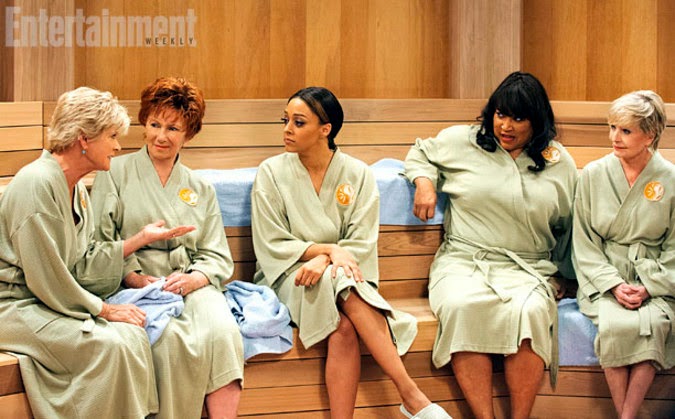
A great salute to TV moms will be on tonight’s episode of INSTANT MOM at 8:00 on Nick at Nite. It features guest appearances by Florence Henderson, Marion Ross, Jackee, and Tempest Bledsoe. The episode is very funny, and just happens to have been written by Annie Levine & Jonathan Emerson. Call your mother for Mother's Day and watch this show.

Wednesday, May 07, 2014

Shows you'll never watch

I was having lunch recently with fellow comedy scribe/blogger Earl Pomerantz and he posed an interesting question. “How many shows do you have on your DVR that you never watch?”

The short answer is: a lot more than I realized.

First off, I’m embarrassed to say there are two of my FRASIER episodes that have been languishing unwatched for about a month. I saw they were going to be on, taped them since I hadn’t seen them in awhile and really liked them, and so far have not found the time to watch them.

The way I know I’m officially over a series is when I see there are eight episodes waiting to be screened. If it’s May and I just now am getting to the Christmas episode, it’s time to cut and run.

THE BLACKLIST was one of those shows. Loved the pilot, stayed with it for half a season, and then it just got too absurd for me. UNDER THE DOME was another. They’d all be dead by now. That’s a logic problem I have trouble getting past.

I used to keep episodes of shows I really liked but then realized I never go back and watch them again. How many times can I see Will Gardner die? Or Piper Perabo run full speed in high heels?

When I hear of new shows coming on I try to catch their debuts. But half the time, when left with the prospect of actually sitting down and watching them, I end up hitting the delete button. Do I really want to devote a half-hour to some new sitcom that the network obviously knows is shit or they wouldn’t have premiered it in May?

Generally, once a month I’ll scroll down the list of movies TCM is showing and flag three or four. And then rarely watch them. In theory, it would be great to see GUNGA DIN again. In reality, why am I going to see GUNGA DIN for the tenth time? The old movies I tend to actually watch tend to be cheesy, kitsch, stunningly bad, B movies. I watched GO JOHNNY GO, a ‘50s rock n’ roll schlock film starring D.J. Alan Freed that made Ed Wood movies seem over produced. THE GREEN SLIME is another masterpiece I caught up with. CITIZEN KANE I deleted.

I’m also quicker on the trigger finger. If there’s a show or movie I’m not lovin’, I’ll kill it in the middle. Why waste my time when THE GREEN SLIME is waiting on my menu?

I’ll also record Dodger games, which is really stupid because they replay them five times a day. Sometimes I think I should save a couple of games because this is probably Vin Scully’s last year calling them, but seriously, five years from now I’m going to keep watching a Dodger-Diamondback game from April of 2014 where the big moment was Mark Trumbo not hitting the cutoff man?

I’ll tape documentaries I hear are great and all caring citizens should watch. But honestly, if I’ve got an hour and my choices are SHARK TANK or political injustice in South Africa I’m watching some idiot try to sell chocolate bars made out of grasshoppers.

There is now sooooo much product. Not only are there shows I’ve never heard of, there are networks I’ve never heard of. So not only do I have to be very selective as to what I want to watch, I have to be very selective among the shows I DO want to watch. Even shows I myself wrote.

DVR capacities are expanding. 200 hours of space. 400 hours of space. But so what? That’s just more hours you can fill with shows you’ll never watch. What we really need to do is add to the length of days. Expand them to 200 hours each. If Steve Jobs were still alive I bet Apple would have introduced such a device. That’s what it’s going to take to start watching WHITE COLLAR again. Or my FRASIERS.

Tuesday, May 06, 2014

Dorothy Parker's advice to aspiring writers

As an addendum to today's post on breaking in:  

What's the best way to break into the business?

Here’s one of those Friday Questions that warrants an entire post.

It’s from A. Wayne Carter:

As a fellow alumni of your partner David Isaac's University of Miami, I was curious on your thoughts of the value of a four-year college degree if you want to be a scriptwriter in Hollywood. Or is it better to just write and get in on a low-level industry job as soon as you can. My ship already sailed on that front (I got the B.A. and started later) but for the benefit of the next gen, what are your thoughts?

School is great, but it’s not mandatory. If you want to become a doctor you can’t just watch a lot of videos and take notes. You kinda have to go to medical school, even if that means Mexico.  That’s not necessarily true when it comes to learning how to write for television.

That said, there’s a lot to be said for getting a great education. You save a lot of steps when you don’t have to reinvent the wheel. A good professor can save you years of making rookie mistakes. And more importantly, can inspire you.  As someone who teaches a course at USC (the above picture shows some of my kids) I certainly believe in the value of an advanced degree. 

Other advantages are being able to immerse yourself in the world of writing surrounded by a built-in support group of fellow students. Writing is a lonely endeavor. It sure helps to have friends who understand. Just having people you can hang out with late at night discussing the structure of this week’s MAD MEN is a God send.

But here’s the thing: to make the college experience really worthwhile, you have to go to the right university and have the right professors. And that can depend on your sensibilities. NYU might be great for some but not you. USC, UCLA, Emerson, Northwestern, Chapman, and Michigan I know offer great programs. I’m sure a lot of others do as well. The great thing about those colleges is that they’ve dumped a lot of graduates into the industry, which is great for networking. Sometimes contacts are more important than degrees.

But remember, just because you’ve graduated with honors at a prestigious feeder university, doesn’t mean you’re guaranteed entry. At the end of the day, it’s talent, desire, preparation, opportunity, and luck that propels someone through the door. It’s quite possible to attain all of those while skirting academia.

Watch thousands of hours of television and analyze it yourself. Write outlines based on what you see. Compare them and start to discover patterns. Read books. Even idiot bloggers.  Write spec after spec. Learn from your mistakes. Your fourth spec will be better than your third.

If you can break in by being a PA or writers’ assistant, jump at it. Again, it’s all about contacts and learning. Being on the inside, watching how a show is produced every week is invaluable.

Obviously, it’s easier to break in if you’re in Los Angeles. You can take extension courses at UCLA, meet industry types, create your own network of fellow aspiring scribes. It’s always better to be where the action is. You wanna build airplanes?  Move to Seattle.  You wanna write scripts for Mindy Kalin?   Head out West. 

But then again, even that’s not mandatory. People from Wisconsin and Tennessee break in by writing plays that get noticed. Or they make YouTube videos that go viral. Or win screenwriting or playwriting competitions. Or winning contests like the one NBC is having. 

If you ask 100 writers how they broke in you’ll get 85 different answers. So you have to decide what’s best for YOU. The good news is, if you don’t get into USC or NYU you don’t have to go to school in Mexico.

As always, best of luck to everyone. Make me proud.

Monday, May 05, 2014

ORPHAN BLACK is the new ORANGE IS THE NEW BLACK

Okay, I know I’m late to the party (by a year) but I finally discovered ORPHAN BLACK. Yes, yes. I am sooooo behind the curve. You’re probably surprised I’ve heard of LAW & ORDER.

Here in the colonies ORPHAN BLACK airs on BBC America on Saturday nights (but I found it ON DEMAND). And it is phenomenal!

Tatiana Maslany deserves not one Emmy for Best Actress in a Drama, but nine – one for each character she plays. ORPHAN BLACK is about clones, but it’s less sci-fi and more character suspense/conspiracy. It takes place in the present on planet Earth so right away it’s groundbreaking for science fiction.  If you can put up with a story that’s not set five years after the Apocalypse, with evil robots controlling the world, and everyone dressing like punk rockers and driving rusted 1998 Buicks you might enjoy this show.
Tatiana Maslany is a revelation. She plays multiple characters, each completely distinct with unique voices, mannerisms, accents, and attitudes. I can only imagine Megan Boone from THE BLACKLIST trying to tackle this acting assignment. Nine wigs, one expression.

Series creators John Fawcett & Graeme Manson have devised an ingenious mystery and their storytelling is superb. This show moves like a bullet train. Things are always happening. There are most twists than in a helix. And along the way they actually ANSWER some questions. Yes, those lead to more questions but at least you’re getting some reward. (If LOST answered every question they posed over the course of the series the finale would still be airing.)

What’s amazing to me is that they’ve found a fresh way to tell a “you never know who to trust” series. God, we’ve seen a million of those. The good guy turns out to be the mole and the bad guy turns out to be the Pope. In this show they really keep you guessing. And because you care about the welfare of these cuddly clones you’re carefully trying to size everybody up. You’re watching for little tells. You’re thinking back to past conversations. Normally you’re saying – “Gregory Itzin? Bad guy. Next.“

Shows like ORPHAN BLACK also live and die by how good their villains are, and Matt Frewer is deliciously understated and evil. Who knew Max Headroom could be so scary?

The rest of the supporting cast is terrific too. My favorite is Jordan Gavaris as clone #2’s gay foster brother. (Or is it clone #3?) There’s a scene where he has to babysit a suburban soccer mom’s kids (clone #4 – wait, maybe she’s clone #2) and teaches them how to cross dress that is funnier than any sitcom scene I’ve seen this year.

Kudos also to the technology. There are some scenes where there are three Tatianas on screen at the same time and it looks seamless. (I only wish they were all watching PARENT TRAP and commenting.) Forget making Superman fly – clones even hand each other things! We’ve come a long way since THE PATTY DUKE SHOW.

ORPHAN BLACK is a series you have to watch from the beginning. But it’s not like one of those shows that starts off slow and you have to get four hours under your belt before it starts to click. The very first scene of ORPHAN BLACK hooks you right in. I can’t wait to see what happens next.

The show is produced in Canada. I hope the US doesn’t do its own version (with Megan Boone) or ANIMAL PLANET doesn’t do its version with sheep.

Sunday, May 04, 2014

My first radio job

I always contend that the only way I got respect in radio was by getting out of it. There was no Billboard Disc Jockey of the Year award for me in the early '70s. Most of the time there were no jobs.

I can’t say my aspirations upon graduating from UCLA were all that high back then. I wanted to play the hits. My ultimate goal was to do nights in San Diego. Not even Los Angeles or San Francisco. I thought with my voice even San Diego was unrealistic.

And of course, when you just get out of college your career planning is not really long range. It never occurred to me that introducing Cher records four hours a night for fifty years might not be the best use of my time or talent. I just wanted to land at a station with a good jingle package. (Another job well done by a faculty career counselor.)

My first real on-air job came while I was still in college. A friend, John was a disc jockey/chief engineer at the number two rock station in Bakersfield. KERN 1410. (Note: Any AM station 1300 or higher on the dial has the signal range of your WIFI router.) He called to say they had an opening – Saturday nights from 6-midnight for $2.50 an hour!! I gasped at my good fortune. Quickly I called the program director (who was on the air at the time... playing "Gypsies Tramps and Thieves"). He said send a tape. I had one ready to go. It was a composite of shows I had done at the UCLA campus station.

I asked if I could drive up there and play it for him. With such a plum assignment as six hours a week on a station no one listened to in the middle of nowhere in sweltering summer heat for minimum wage I didn’t want to leave anything to chance.


So on the 4th of July in Africa-hot heat I drove the 90 miles up to Bakersfield -- the Jewel of the Central Valley.

The station itself was a shack flanked by one tower in a giant empty field. The previous tenant was probably the Unibomber. I met the program director, your standard long-haired hippy freak/radio executive who took me into the production studio, which was the size of the bathroom in a Greyhound bus. I was very proud of this tape. It must've taken me twenty hours to assemble. He wound it on the old machine, and hit play. “It’s 6:00 on…” He shut it off. “Yeah, you’re fine. You start Saturday”.

I was ecstatic.

He asked me what name I wanted to use. This threw me a little. Couldn’t I just use Ken Levine? “I dunno, “ he said, “That sounds almost Jewish.” (Almost Jewish???) He suggested instead “R.K. Olsen”. (RKO owned a lot of big stations back then like KHJ, KFRC, and WOR. It was an inside joke for six people on the planet). We settled on Ken Stevens. Who knew I’d be going through Ellis Island in Bakersfield?

Still, this was unbelievable. Our campus station only went to the dorms. This station I could hear in my car! At least for the first six minutes driving back home at midnight.

For three months I commuted every weekend to Bakersfield. My radiator blew twice, my car overheated numerous times, I got a flat tire, snapped three fan belts, and one weekend I received two speeding tickets from the same cop at the same spot coming and going.

But it was worth every dollar I had to borrow to keep this glorious job.

And then they gave me Sundays from noon to six to go along my Saturday night shift. I did that for about a year, sleeping every Saturday night on John's threadbare couch.

At first I was terrible on the air. No tapes exist. But eventually I got comfortable. In other words, I started doing more comedy (LOTS more comedy). The program director left, replaced ironically by my friend, John. He really whipped the station into shape. And the next summer when the ratings came out (they only came out once a year in Bakersfield) KERN amazingly beat the longtime powerhouse KAFY despite their massive signal and better jingles.

And my ratings on Sunday afternoons were staggering. Believe me, I owe it all to the comedy. Otherwise I had no pipes and no real style. Still I wonder – if I had gone by the name Ken Levine, would my share have been slightly lower? Maybe 40? Or 8?

Update:

Thanks to Johnny Mitchell, my PD at KERN for holding on to the ratings.  They're just too good not to share.

From the April/May 1972 ARB report for Metro Area shares for KERN:

Sat. 7-M Teens 52.4
Men 18-34 57.1
Women 18-34 43.8
Men 18+ 36.8
Women 18+ 21.9
Persons 12+ 36.3*

Sun. 3-7 Teens - 47.5 Men 18-34 - 29.7
Women 18-34 16.0
Men 18+ 19.5
Women 18+ 11.4
Persons 12+ 21.0

* The highest 12+ rating in any time period ever recorded for KERN. (The next closest was
27.6)

Thanks again, Johnny.  I owe you lunch and a new couch. 

Saturday, May 03, 2014

Don't forget Neil Simon

A number of years ago at the Daily Grill in Brentwood I was waiting at the valet for my car and there was Neil Simon waiting for his (a nicer one by the way). I mentioned to my kids, who were quite young then, that Mr. Simon was one of greatest writers in America and my son said, “Then how come we’ve never of him?” I laughed of course. Everyone knew who he was. Then.

But now I wonder: how many people today do know who he is? From the 60s through the end of the centry Neil Simon was the king. Name me a comedy writer who got his name above the title of any play or movie he wrote. Or a screenwriter who the studios and directors were forbidden to rewrite. You’ve got to be pretty good and pretty successful to achieve that kind of clout. For God sakes, the man has a Broadway theatre named after him.

Today Neil is in his advancing years and his output of material has slowed considerably. Thus it’s quite conceivable that many young people don’t know who Neil Simon is.

So for young writers hoping to break in and just fans of mirth in general, I say don’t forget Neil Simon. Yes, he’s from another era. And I can’t imagine him ever writing SUPERBAD or FAMILY GUY. But any serious student of comedy will find much to learn (and enjoy) from studying the work of Neil Simon.

His jokes are all so well-crafted and all come out of character. Just once in my life I’d like to write a joke this good: From THE ODD COUPLE when slovenly Oscar confronts fastidious Felix –

“I can't take it anymore, Felix, I'm cracking up. Everything you do irritates me. And when you're not here, the things I know you're gonna do when you come in irritate me. You leave me little notes on my pillow. Told you 158 times I can't stand little notes on my pillow. "We're all out of cornflakes. F.U." Took me three hours to figure out F.U. was Felix Ungar!”

There are two soft-cover collections of Neil Simon plays. Even though they may seem dated (since they are from the ancient 60s when dinosaurs still roamed the earth ), check out the early ones. BAREFOOT IN THE PARK, COME BLOW YOUR HORN (his first play), and the incomparable ODD COUPLE. Notice the rhythm, the pace, how each joke moves the story forward, and how each joke just seamlessly flows into the next.

His later work adds drama and depth and of those plays I would suggest BILOXI BLUES, LOST IN YONKERS, and THE SUNSHINE BOYS but there are two or three others you might like even better. He doesn’t get the credit he deserves for his more serious work but hey, that’s the cross all of us yuckmeisters have to bear.

And again, read the plays. Sometimes the movies don’t do the properties justice. Obviously, aspiring scribes should inhale every script of COMMUNITY and 30 ROCK and MODERN FAMILY that they can find, but also add some Neil Simon. There’s pearls to glean from a guy who can write…

Oscar Madison: I know him. He'll kill himself just to spite me. Then his ghost will come back, following me around the apartment, haunting and cleaning, haunting and cleaning, haunting and cleaning...

Friday, May 02, 2014

Friday Questions

More Friday Questions comin’ attcha.

Liggie starts us off:

When screenplays are sold in collectible stores (three brad-bound, Courier font, etc.) or in a book format in bookstores, does the screenwriter get a royalty from that?

No. When actual shooting scripts are sold on remainder tables in bookstores (or on the streets in Manhattan), no one involved in the production from the studio to the writer are compensated. Technically, these merchants are selling stolen property.

I’m somewhat ambivalent about this issue. On the one hand, others are profiting from my work. On the other, these scripts generally sell for just a few bucks and when I was starting out, the only access I had to a television script was through these bookstores. I bought an ODD COUPLE script and a MARY TYLER MOORE SHOW script and learned to write by studying those two scripts.

If a script I wrote can inspire or instruct others then I feel I’m paying it forward. That’s worth more to me than the few cents I'd be making from the sale.

As for scripts of mine included in a published book, the studio owns the copyright so I have no say. Our “Room Service” episode was included in a book of FRASIER scripts. It would have been nice to share in the royalties, but honestly, it was an honor just to be included. There have been some damn fine FRASIER scripts over the years.

Rob Larkin queries:

I'm curious as to how you and your writing partner David Isaacs pitch an idea or story. Do you decide beforehand who will do most of the talking or is it spontaneous?

For some reason I usually start the pitch and then we do it together. David will pick up the ball for awhile then toss it back to me, etc.

I hear stories of writers carefully rehearsing their pitch, even memorizing it. We never do that. We have a beat sheet that has the main points we need to convey and generally a few jokes, but beyond that we’re spontaneous. We’re having a conversation with someone, not delivering a slick sales pitch.

And as important as pitching is, we try to make sure the idea is worth pitching. Ultimately, that’s what sells a project – the idea.

blogward wonders:

Ken, what's your take on Tom Lehrer? It came up on the web recently that he couldn't give a damn about copyright on his songs, or performing at all. This is the man who lick-started the UK satire boom.

I love Tom Lehrer. For those not familiar with him, he was a mathematician and taught political science at M.I.T. in the '60s and in his spare time composed and performed satiric songs. He developed a huge following, record albums followed, and his songs were quite popular in the ‘60s and ‘70s. In the early ‘70s he quit show business and resumed his academic career at U.C. Santa Cruz. God bless him, he is 86. 

I always found his material to be hilarious, so smart, and so unique. He came along at a time when folksingers were taking themselves and the world sooo seriously. He was a breath of fresh air.

Here’s an example of Tom Lehrer:


From Garrett:

Last night's Big Bang Theory seemed to have a dozen people between the written by, teleplay by and story by. Does that mean it was just a bad story that need intensive care?

No. It means that the writing credit is meaningless. Every BIG BANG THEORY script is room written, and since the WGA forbids you from listing fifteen writers for one writing credit, they rotate credit among the staff. So the writer who got shared story credit and the writer who got shared teleplay credit did as much or as little as the other dozen writers who received no credit that week.

What’s your question? Leave it in the comments section. Thanks.

Thursday, May 01, 2014

May Day (Malone)


With this being May Day, I thought I’d focus today’s post on Sam “Mayday” Malone (not that I haven’t mentioned him 46 times already this year).

First off, as I’m sure you know, I greatly admire Ted Danson, both as a person and an actor. So I’ll skip the two paragraphs of fawning that would otherwise go with this profile.

Some things you may know; some you may not.

As originally conceived by the Charles Brothers, Sam Malone was a former football player for the Patriots. Fred Dryer was more who they had in mind. And he was a finalist for the role (along with William Devane).

Ted however, was so charming and there was such chemistry with Shelley Long that they decided to cast him instead. But Ted as a football bruiser is only slightly more believable than me as an NFL lineman so they made Sam a baseball player instead.

The supposed photo of Sam in uniform at the bar was really Red Sox pitcher Jim Lonborg.

To prepare for the role Ted went to bartending school.

Over the course of eleven years he must’ve cut up 18,000,000 lemons. Actors always like to have some “business;” something to do. The obvious thing for him would be to make drinks all the time, but then the waitresses would have to get them, deliver them to tables, etc. Cutting lemons was an activity that required no further logistics. (I jokingly used to say that Sam should sell the bar and become a sushi chef.)

Ted really struggled finding the character in the first season because in real life he’s so unlike Sam Malone. He’s not a womanizer, not a jock, not vain, and not a recovering alcoholic. The fact that he appears so convincing and so effortless is a real testament to just how excellent an actor he is. (Again, jokingly, I used say it was okay if he wanted to model the character after me.) 

Over the course of the series Sam became dumber, a decision that offered more room for comedy, but I never liked it. Most characters grow and evolve over time. Personally, my favorite version of Sam Malone was the one in the pilot.

Ted never threw his weight around as the star. One day the Charles Brothers, Jimmy Burrows, David and I, our line producer and editor were in Les’ office going over a roughcut. Ted wandered in and sat down. Glen hit pause, Les politely told Ted that actors were not allowed to sit in on editing, and Ted apologized and ducked out. I can think of ten other stars who would have reacted quite differently.

Ted was always protective of the other cast members, guest cast, and extras. Oh wait. I said I wouldn’t fawn.

Ted never watched the show when it was on the air. He felt he would be too self-critical and would tinker with his performance – possibly ruining it.  Years after CHEERS ended Ted finally began watching, and guess what? He really liked it.

How accurate is testing? In one of the later seasons Sam’s arc was that he was trying to get Rebecca into bed. We had him do some of the most horrible deceitful things. Audience testing came back and Ted ranked the highest. He was most likeable – seen as a father figure to everyone at the bar. What show were they watching? (Meanwhile, Frasier tested the worst.)

Ted rarely complained about the material. And when he did, he was always respectful. And most always right.

CHEERS ended after eleven seasons because Ted decided he no longer wanted to do the show. Many blame Whoopi Goldberg (his girlfriend at the time). They felt she swayed his decision. I think he left for another reason. I’ve never discussed this with him, but my feeling is he knew that at a certain age the character would border on sad. The slick player might seem very charming in his 30’s but a little pathetic in his 40’s. I think he left because he was protecting Sam Malone.

A few years later, he reprised the character on FRASIER – an episode my partner David Isaacs and I wrote – and we tried to address that by getting him engaged. Ultimately, the wedding was called off, but we wanted to convey that Sam was aware of his situation and was actively trying to move on. Even with that, I still got the sense Ted was somewhat uncomfortable playing Sam Malone again.

BECKER was a spec script written by Dave Hackel. The main reasons why Ted responded to it was (a) it was very well written, and (b) the character was so unlike Sam. Ted wanted to distance himself from Sam and play something very different and age-appropriate. For that I give him so much credit. How many sitcom stars have you seen who continue to play essentially the same character in series after series, even after they’ve long since outgrown that character? (Who remembers LIFE WITH LUCY?)

And finally, Ted truly found his soulmate in Mary Steenburgen. If ever there was a perfect match it’s those two. Sam & Diane could only dream of such a marriage.

Happy May Day.