Monday, October 08, 2012

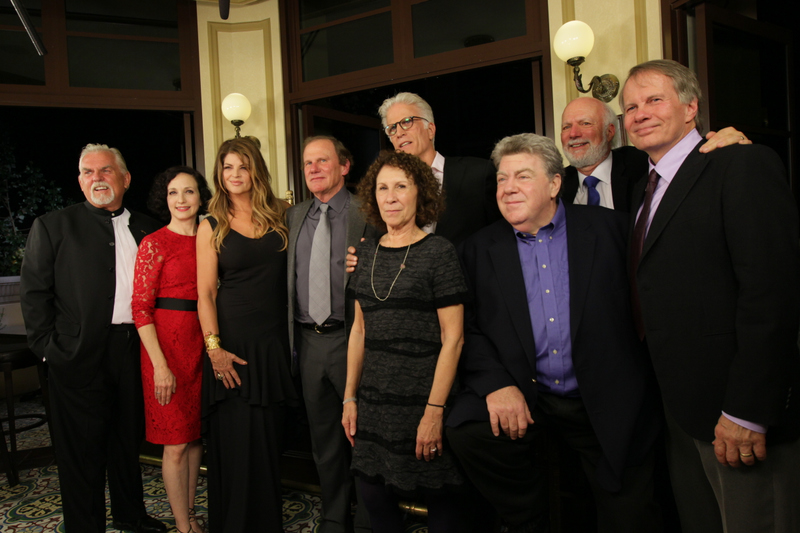
More photos from the CHEERS reunion party

Most of these are compliments of AP.  Warning:  many of these photos are of writers.  Names you've seen on the screen for years.  But maybe now for the first time you'll be able to put the face with the name.

If you haven't read my re-cap of the night, you can find it here.
The Bouchon Bistro -- ET won't show you this.
Jimmy Burrows and one of his many proteges.
Director Andy Ackerman, Glen Charles, and Sam Simon
Either Glen Charles is dying his hair or that's me with his brother Les.
Peter Casey and Tim "Mad Dog" Berry
Writer Ken Estin and his lovely daughter
Okay, so it wasn't just writers at the party.
Many Perlmans with Jim Burrows.  Rhea on one side and on the other -- writer Heide with her daughter Ruby.
Ted, Shelley, and Nancy O'Dell from ET
The reason there is a CHEERS -- Glen Charles, Jimmy Burrow, and Les Charles.
Writers Dan Staley and Cheri Steinkellner
For those who wondered what "Phoef" looked like -- Phoef Sutton and one of the actors.
Right out of Broadway Danny Rose -- writers Mert Rich, David Isaacs, Brian Pollack, and me.

The CHEERS 30th Reunion Party

You know it’s a great party when it lasts for six hours. The CHEERS 30th reunion bash Saturday night in Beverly Hills was the perfect blend of laughter, tears, memories, and alcohol. If ever they gave an Emmy for “Best Show Party” (and they really should – it makes as much sense as Best Reality Show Host) Jimmy Burrows and Glen & Les Charles would win that too. It was like my 30th high school reunion except I couldn’t impress anybody that I worked on CHEERS because everybody there worked on CHEERS. We all looked pretty good for thirty years – even the writers.
Me, Glen Charles, David Isaacs
I wore the CHEERS tie I had gotten somewhere. Not many places I can wear that. CHEERS reunions and maybe Comic-Con.

The soiree was held at the Bouchon Bistro so you know the food was going to be better than the Rosendorf wedding at Leonard’s of Great Neck. And it was. No wonder everyone including the busboys have their own shows on the Food Network.
ET was there, so you know it had to be important. For some odd reason they only wanted to shoot footage of the actors. But just knowing I was at an event covered by ENTERTAINMENT TONIGHT gave me the warm delusion of still being in the business. I imagine the segment will air tonight following the story on whatever singer Chris Brown beat up over the weekend.

I said to Ted Danson when I greeted him: “Hey, there’s a dead body in the stairwell I think you should look at.” And Ted replied: “I already counted the maggots.” Ted is in his second year starring on CSI.

Spent some time talking to the very busy Shelley Long. She did five movies this year. I haven’t seen five movies this year. When she and Ted chatted it’s like they weren’t Ted Danson and Shelley Long. They were Sam & Diane. And they always will be.
Kirstie looks spectacular. She’s dancing ten hours a day rehearsing for DANCING WITH THE STARS. Former DWTS contestant John Ratzenberger agreed it was grueling. (Oh, the fun we could have had with Cliff the dancing mailman.) Ironically, Bebe Neuwirth, who is a dancer and could win that competition with both legs in a cast hasn’t entered. Forget the babes on REVENGE and SCANDAL. Lilith is still hot, boys!
George Wendt was happy because Notre Dame beat the shit out of the University of Miami. My writing partner, David, was less ecstatic. Rhea was there with her sister, fellow writer Heide Perlman. And you know how on Saturday I talked about their dad being an extra on the show? Happy to report he’s 93 and still going strong. Living off the residuals I’m sure.

Only main cast members missing were Kelsey Grammer (who is out of the country) and Woody Harrelson (I don't know where Woody was, but I'm not sure he knew either).  However, they both sent lovely videos.

Friend of the blog, Jackie Swanson was there. She says a month doesn’t go by when somebody doesn’t sing “Kelly, Kelly, Kelly, Kelly” to her.  I'd be slugging people by now but she doesn't mind. Jean Kasem (Loretta) and Paul Willson (Paul) also attended. CHEERS had some pretty great semi-regulars, didn’t they? I didn’t see Fred Dryer (sportscaster Dave), but I see him all the time at the gym so I didn’t feel cheated.

Judy Hart Angelo, who penned the lyrics to the theme song was there.  Who could have possibly predicted thirty years ago that when she wrote "Where everybody knows your name"that she'd be helping to sell State Farm Insurance?

Now that we have iPhones, everyone was taking pictures all night of everyone else. There were a couple of professional photographers hovering. I bet they have sixteen shots of Bebe and Rhea taking photos of other people.

Was seated at a table with enormously talented CHEERS writers – a few of them (Dan O’Shannon, Dan Staley, and Phoef Sutton) are still employed if you can believe it. Lots of laughs and begging the working writers for jobs.

The highlight of the evening came after dinner. Our gracious hosts put together an amazing 38-minute compilation video of the “Best of CHEERS.” It seemed like ten minutes. I can’t begin to express how proud I am to be a part of such an extraordinary body of work. And then how nice to be able to personally thank those responsible.

The video ended with all of our credits, the number of Emmys the show won (28), the number of children born during its eleven-year run (37 – my son Matt was the first. Happy 30th birthday in three weeks, Matt), and a list of those we lost. They deserve recognition in this piece as well. Nicolas Colosanto, David & Lynn Angell, David Lloyd, Jerry Belson, Brandon Tartikoff, Steven Kolzak, Gary Nardino, Linda Burrows, and Maryann Charles.

I should have known better but didn’t. I thought, “Nah, they’re not going to do it.” Sure enough, Jimmy got up and began passing the microphone around for toasts. They were funny, lovely, touching, and very spontaneous because like me, no one thought they’d do this again. Fortunately, these people have all had ample practice in award acceptance speeches. Les Charles said, “Even if CHEERS had only lasted one year it would have been the greatest experience of my life. Of course I’d now be valet parking.” And Jimmy reminded us of the late great Jerry Belson’s toast on the night CHEERS first premiered. Jerry stood up and said, “Y’know, I’ve been on a lot of shows…” and then he sat back down.
Mary Steenburgen & Ted

The toasts finally ended after four strangers spoke.  More circulating and reminiscing until about 1:00 in the morning. You know how people say, “we should get together” but never do? I made a vow to follow up with everyone I said that to. Now let's see if they take my calls.

As I watched the highlights video – filled with pride and counting the number of our episodes they included – I thought, what a tremendous gift. Not only did we all do work we’re extremely proud of, but that work is still being seen and enjoyed today. CHEERS remains on the air in syndication as well as on a few cable networks. DVD’s are available, and now you can watch the entire eleven seasons on Netflix. I invite fans of the show to revisit it, and I especially invite young people who haven’t seen CHEERS to check it out. By the second time you hear the words, “magnificent pagan beast” you’ll be hooked, I promise.

Again, my thanks to Jim Burrows and Glen & Les Charles for a magic night, a career, and those marshmallow party favors. Those were great! See you at THE TORTELLIS reunion.

Sunday, October 07, 2012

Why Week Two is often Weak Two

For most new shows this is the toughest week of the year. Week two.

The phony network hype begins, already heralding the next big hit of the season based on only one airing. The same hype that gleefully proclaimed WHOOPI the smash of the season and COMMANDER-IN-CHIEF the breakout hit of 2005 (and I'm sure you're going, "Huh?  Were those even shows?"). This year they’re saying VEGAS is America's #1 New Drama but I don’t know a single person who's seen it.

All this bogus hype just adds unrealistic pressure. And every showrunner knows -- as tough as it is to do a good pilot -- that’s nothing compared to episode two.

Generally, you have months to write and polish your pilot. You have a week to bang out episode two.

Drama pilots often have big budgets. And big name feature directors. For week two you get the guy who directed a few DEGRASSI HIGHS and instead of spectacular stunts worthy of James Bond movies you must settle for a car that can fishtail.

And good luck spotting movie star executive producers like Hugh Jackman and Salma Hayek in anything but the pilot. They’d lose their invitations to Jeff Katzenberg’s picnic if they appeared in “episodic” television beyond the premiere.

A lot of pilots are “premise pilots” (discussed pretty much to death in this blog) – they show the major events that set the series in motion. For all the advantages of premise pilots, you pay the price week two.  What are they going to do on LAST RESORT?   Invade another island?  Fire another nuclear missile?   On BEWITCHED -- Darren finds out Samantha is also Jewish?

For a while networks were demanding we don’t do premise pilots. So in essence, we were writing a second show AS a pilot which combines the hardest aspects of both assignments. And then our second episode had to be essentially ANOTHER second episode.

People watch the second episode with different expectations. Some saw and loved the pilot and expect the follow-up to be just as good (despite the limitations). Others saw the pilot, are still on the fence but are willing to give the show another try. You have this one last chance to win them over. Gulp! And most people who tune in didn’t see the pilot. You have to get them caught up while not boring the viewers who don’t need a recap. It’s a tough line to straddle. 

Obviously some shows can do the “Previously on…” prelude, but that usually works best on serialized programs. And still on those shows, with big casts, you’re spending half the episode trying to figure out who the hell all these people are and why the main character is named Jack in every series.  (See my attempt to catch up on GAME OF THRONES.)
 
Bottom line: Second shows are a bitch so give ‘em a little slack this week. And Fox fall shows have it even worse. Because of the baseball playoffs their new entries disappear after a couple airings. So when they return they need to present yet another pilot episode. If THE LAST RESORT were on Fox they'd be nuking Europe already just to get you up to speed. Such are the problems facing today’s TV showrunners.

Update: Tomorrow a report on last night's CHEERS 30th reunion party complete with lots of pictures.  It's 10:17 a.m. and I just woke up.  

Saturday, October 06, 2012

The CHEERS names not everyone knows

CHEERS is 30 years old.  Tonight there is a reunion party for those of us honored enough to be part of the show.  Will let you know how it goes.  I wonder if anyone besides me will not have aged in all that time.  Anyway, you all know the stars.  But what about the others who populated the bar?  I thought today I'd recognize them so the next time you watch you will too.
 
First up is Al Rosen -- the old rummy.  Al was really a championship TV wrestler back in the 50’s. He was the MAN WHO SAID SINATRA. Al sometimes needed two or three or eight takes to get his line right but it was always worth it. In one episode we wrote that someone referenced in the comments (“the Big Kiss Off”), he was supposed to come out of the back and deliver a joke. The first two takes he went up on the line. The third take he was perfect and got a big laugh. One problem though. In the first two takes he enters holding a drink. In the third he doesn’t but is holding his hand as if he DID have a drink in it. It looks totally bizarre, but we went with it because he got the line right. If you have the DVD check it out.

The older gentleman always referred to as Phil -- that’s Phil Perlman, Rhea’s dad (pictured left). Once we started giving him lines he listed himself in the credits as Philip Perlman.

Tom Babson wound up becoming a semi-regular. Cliff was always ragging on him for attending law school. Tom at various times was listed as “Tom”, “Tom Babson”, “Tom Ballard”, “Customer #1”, and “Barney”. But you may know him from KNOTS LANDING where he played “Man”.

In the later years, “Paul” also became a semi regular. He’s Paul Willson (pictured right), a gifted comic actor and one of the greatest improv artists I have EVER seen. I put him up there with Robin Williams. I feel bad for Paul because we finally built an episode around him but it was the second to the last one of the series. He pops up on a lot of shows. Always funny.

One of the great sports columnists of all-time, Alan Malamud, sat at the bar for eight or nine shows. Local LA sportscaster, Steve Bailey, had a drink from time to time, as well.

I show up in only one scene in one episode, the last Bar Wars.

All of the customers hoped that their parts would expand and become a series regulars as what happened with John Ratzenberger and George Wendt. It was never to be.

And then there’s the bar patron who was supposed to be a series regular and wound up as just an extra. In the pilot from time to time you see an old woman in the background. This was “Mrs. Littlefield”, a colorful politically opinionated spinster. She had a number of lines in the pilot. But the show was long, her character didn’t really score, and her part was cut. All that remains are a few shots of her here and there.

And finally, in a few episodes my father plays an extra. You’ll see him hitting on 25 year old women. My idea. You're welcome, Dad.

the SITCOM ROOM is SOLD OUT

Sorry I couldn't take more, but I had to limit the number of participants to make sure everyone gets a real "writers room" experience, my full attention, and enough Red Vines.

However...

We do have a waiting list.

Although it's unlikely, occasionally we do get a cancellation.

So if you're kicking yourself for not being among the first 20 to register, you can put yourself on the waiting list.

And to this year’s crop of brave, adventuresome sitcom writers:

Can’t wait to see you in L.A. next month!

Update:  Just got this Tweet from a former attendee:


try standby list:I did lst yr,snuck in,best $ I ever spent in RT SITCOM ROOM is SOLD OUT

Friday, October 05, 2012

Only one opening remains

... for this year's SITCOM ROOM seminar - November 10 & 11 in Los Angeles.  I only hold these seminars once a year and we're sold out, that's it.

Here's where you go for information and to register.  

But why take it from me that this is an amazing experience when you can hear it from one of last year's attendees, Steve Murray?

To anyone who is still debating whether or not Ken's Sitcom Room is worth the investment, let me tell you that after years of pretending to be serious about writing for TV, my experience last November changed my attitude, approach and appreciation of the process completely. I have since devoted myself full-time to writing, based on what I learned during that wonderful weekend, and now know that a career as a television writer doesn't have to remain simply a dream. Live in a different state? I came from the other side of the world. Prefer to save up your hard earned for 'next time'? You're only delaying your potential life changing experience by 12 months. And who knows what excuses you might have in another year's time?

So  there you go.  Hope to see you in November.  Remember -- only one slot left.  So space is sorta... y'know... limited.

THE SITCOM ROOM

Hire funny people... and women ARE funny people

Got a Friday Question?

Rebecca does:

I noticed this year that nearly every pilot features a really hot cast. But a lot of the enduring classic sitcoms actually feature a cast of average-looking people. Seinfeld, Golden Girls, Cheers, Two 1/2 Men, Everybody Loves Raymond etc. So why do new shows only feature hot people? Is this a case of network executives being out of touch and just assuming we only want to look at hot people? Will us average people ever get to relate to a tv show again?

Very simply: the networks want pretty people. Which is fine, but those of us who produce comedies want FUNNY people. If they are also beautiful that’s fine… as long as their beauty doesn’t take away from who that character is. It makes no sense to create a character who’s a nerd and insecure because he can’t get dates and cast Justin Timberlake.

The greatest example of this is the U.K. and American versions of COUPLING. The British version, created by the insanely talented Steven Moffat featured a wonderful cast of rich characters – flawed, goofy, real. And he cast the show accordingly.

When NBC, during Jeff Zucker’s rein of terror, adapted it for U.S. audiences they cast J. Crew models. Just compare the two casts. I bet you can tell which was the US version.
As a quick aside, I disagree with Nikki Finke who believes attractive women can’t be funny because they don’t understand pain and rejection. There are so many examples of funny attractive women from Carole Lombard to Julie Bowen that’s it’s absurd to even list them.

Powerhouse Salter wonders:

What would you say justifies writing a rain or wind scene into a script? I mean, why introduce the production cost and logistics of staging fake rain or wind instead of just writing the scene for fair weather?

If the weather figures into the plot. I directed an episode of EVERYBODY LOVES RAYMOND where their daughter’s pet hamster died and they decided to hold a funeral in the backyard. To complicate matters, it rained. This made for a much funnier scene. Interestingly, we shot the scene on the stage in front of the audience.

Yes, it’s an added expense but you just have to decide whether (or “weather”) it’s worth it.

Ed Blonski asks:

What does a "story consultant" do? Like Jay Folb on MASH.

First, understand that all these titles you see on the screen are made up. In Jay’s case, he was a full-time staff writer. But usually when you see “consultant” that means the writer is part-time in some capacity. Either he comes in one night a week to help punch up the script, or works on staff for a day or two. The terms are all negotiated. But whatever title you see, just change it in your mind to “he works here.”

Jill Pinnella Corso has a question about my post on winning an Emmy.

Hilarious! Did you really get locked out?

Yes. You think the Gods of Show Business were trying to tell me something?

It's a big achievement. Did you feel extremely proud? Or paranoid that now something bad must happen? Or anxious about living up to it? Did it open any doors (excluding the one that locked on you)?

I don't know how you felt but I hope you were and are very proud.

I felt extremely proud. Not being remotely athletic, it was the first trophy I had ever won.

I never felt anxious about trying to live up to it. So many things have to fall into place. You can write the greatest script of the century but if it’s for THE WIRE you’re not going to get an Emmy.  Some of the best scripts I've ever written are unproduced pilots and screenplays. 

Does winning open any doors? Probably. For awhile. But the great thing is you’re now forever identified as an Emmy winner. This comes in real handy if you’re single or go to your high school reunion.

What’s your question? Please leave it in the comments section and have a great weekend (in that order).

Thursday, October 04, 2012

A look into the creative process

Yesterday’s piece was purely for laughs. But today I want to use it for instructional purposes. The scene could easily be the opening of a pilot (albeit a premise pilot). Now that you’ve read it and (hopefully) found it amusing (one reader said it was very stereotypical. I prefer to view it as recognizable legitimate behavior. But you decide), let me walk you through my thought process on how I wrote it. This is the kind of thing we do in my Sitcom Room seminar.

Start with a funny premise. Give yourself a situation ripe for comedy. The Superman legend is so white bread middle-America. I thought a Jewish couple would put a good spin to it.  If the premise is funny, the ideas and jokes will easily come.  If the premise is not, you're passing kidney stones for forty pages. 

EXT. CORNFIELD – SMALLVILLE, KANSAS -- DAY (1990)

I chose 1990 so that if I want to continue this series and put Superman in the present day, this is when this scene would occur. When I settled on the year I went to Google and looked up events, movies, and TV shows of the era. The more specific the better.

A rocket hurtles out of the sky and lands with a crash, a plume of smoke trailing behind it.

A 1988 Kia comes down the road. Inside are Yetta and Morris, a middle-aged Jewish couple.

What would this couple drive? It’s just the two of them so a small car. They probably don't buy a new car every year. And of the small cars out there Kia seems the funniest.

YETTA: Morris, stop the car!

MORRIS: Why?

YETTA: What do you mean why? Didn’t you just see that?

MORRIS: Let’s not get involved.

To me this one line tells you exactly who this character is. Every line, besides being funny, needs to better inform us of who these characters are. They tell us by their attitudes, their decisions, their language.

YETTA: Stop the car or so help me I’m taping over BAYWATCH.

BAYWATCH – cheap thrills for repressed middle-aged men.  They don't even watch porn.  They watch BAYWATCH.  And this shows Yetta knows how to get to him.

MORRIS: Alright. Alright. I’ll stop the car. Leave it to you to want to examine every little object that falls out of the sky.

Mission accomplished.  But he needs to save face, hence the little dig at her.

YETTA: You know that's a terrible show, right?

He made a point of quickly changing the subject away from BAYWATCH. She gets back at him for the little dig by bringing it up again. And it suggests that they’ve discussed this topic before and perhaps he defended it, which has to be the most transparent defense in history.

MORRIS: Look, I stopped the car, okay?!

Again, he doesn’t want to talk about it. She knows how to push his buttons.

YETTA: Let's have a look.

She gets out of the car.

MORRIS: What? We're getting out of the car? Aren’t we trespassing?

It always helps to have two people with differing attitudes. So if she is gung ho to explore this, you have more to play if he doesn’t.

YETTA: Oh shut up.

He follows her across the field.

MORRIS: Who knows? Someone may come and think we did this.

You have to cover their crossing the field. He offers lame justifications for his position.

They arrive at the scene.

YETTA: It’s some sort of rocket.

MORRIS: Great. You happy now? It’s a rocket. Let’s go.

YETTA: Aren’t you even curious as to how it got here?

MORRIS: No. It’s a rocket. Who shoots rockets? Kids. Skinheads. For all we know there’s a Hitler Youth group in Smallville and it's der Fuehrer Air Power Day.

He wants nothing to do with this. His assumption is that it’s anti-Semites. And he exaggerates for comic purposes.  If the scene were today the first guess would be terrorist.  And if it was set in 1962 the suspected culprit would be Russia. 

YETTA: That’s ridiculous.

MORRIS: You haven't been to the Dairy Queen lately.

Yeah, like that's proof. 

YETTA: (examining closer) Wait a minute. Morris, I think there’s a baby inside.

MORRIS: Okay. Now we’re leaving for sure.

YETTA: I swear I'm erasing all eight episodes of BAYWATCH.

Pushing his buttons. For all his bluster, this is a woman who gets what she wants. We see the dynamic of the relationship.

MORRIS: Well then just kill me!

He gives up.

YETTA: Who do think would do such a thing?

MORRIS: I told you, the skinheads. There's probably a new chapter -- Hitler Toddlers.

The one explanation they don’t consider is that it’s a rocket from outer space. Rational people tend to consider the more logical, plausible explanations. But what if two teenagers found it? They might jump right to a UFO. So again, how characters rationalize something they don’t understand tells us who they are.

YETTA: Well, we’ve got to get the poor thing out.

MORRIS: I’ll call the Auto Club.

He doesn’t want to do it himself.

YETTA: We can’t wait forty-five minutes. Give me a hand. We’ve got to get it out ourselves.

She’s clearly the person who drives their relationship. At this point we have to cover some business. We need them to open the rocket, which will take some time and preparation. How can we do that in an entertaining fashion?

MORRIS: What? Us? Are you crazy? That thing is hot. What if I order a pizza? They’ll be here in thirty minutes or less. Let the pizza boy open the rocket. I'll tip him.

YETTA: I should have married Saul Gazin.

A good tip: Go off topic. There are ways of getting him to do something without being on the nose – “You’re so lazy. You never do anything.” Etc. She’s pushing his buttons again. Guilt.

MORRIS: Oh, again with the "Saul Gazin". Mr. Perfect. He’d get the baby out. He probably has oven mitts right there in his glove compartment just for an emergency like this.

This must be a card she uses all the time. He tries to show that he’s immune to it with a sarcastic remark. Actors talk about each line having an “objective.” Whether conscious or unconscious, that’s something good for all screenwriters to keep in mind. His objective: “Oh stop throwing Saul Gazin in my face. I’m tired of it!”

YETTA: My mother and the entire congregation was right about you.

She won’t let it drop. We saw her do that before with BAYWATCH. She’s essentially saying, “I don’t care that you’re tired of it. I’m going to keep harping.” And why does she keep doing it? Because she’s a horrible person? No.  She's the one who wants to save the baby.  It’s because she knows it works.

She takes off her sweater, wraps it around her hand for protection and begins pulling at the latch. Out of guilt he wraps his jacket around his hand and joins in.

MORRIS: Move away. I’ll do this.

Sure enough. She has guilted him into it.

YETTA: Thank you. You're such a prince.

Subtext: You should have offered in the first place, asshole. 

He yanks and pulls and strains.

We’ve got to cover this activity. It’s unrealistic to think the hatch would just pop right open.

MORRIS: If my back goes out, good luck getting the Nazis to pay for my medical bills.

Call-backs – always a good comedy staple.

YETTA: Maybe if you exercised more than once every fifteen years.

She returns his volley.

MORRIS: Do YOU want to do this?

He calls her on it.

YETTA: No. Fine. Keep going.

She backs down. It’s nice to see him get a victory once in a while.

MORRIS: Stop nagging. I’ve never broken into a rocket before.

Telling the audience why it’s taking so much time. And again, all these messages are best delivered through jokes.

YETTA: Sorry… but you really do have no muscle tone.

A trait now well established – she can’t let things go.

Finally, the latch opens.

MORRIS: There!

YETTA: Oh thank God!

She sweeps the baby up into her arms.

YETTA: He is so cute.

MORRIS: He? Then that rules out China.

Another call-back. Still searching for an explanation to this. And it seems amusing that that's what he's thinking about.  A baby is pulled from a spacecraft and he's still mulling over how it got there?

YETTA: Why would anyone do this to a precious little baby?

MORRIS: You’re looking for answers? In this crazy world? Why can't they solve the Middle East? How could a thing like the Exxon Valdez oil spill happen? How did Rick Dees get a national television show? I think the real question here is what are we going to do with him? Does Protective Services have a UFO division?

Google helped here in finding specific events. And it was my chance to take a gratuitous shot at Rick Dees. That one was for me. Now comes a tough turn we have to make:

YETTA: Morris, why don’t we keep him?

MORRIS: What?!

Bear in mind that characters have to react to news they weren’t expecting. It may seem like just extra lines to have characters say “What?” or “Pardon me?” but the actors need them and you need them to make your scene flow.

YETTA: We always wanted a baby.

MORRIS: Yetta, that’s insane. We also want a time share in Hawaii.

I could have ended the line with “that’s insane” but it’s an opportunity for a joke.  When you go back through your script, look for these.  I bet you find four or five... or twenty.  

YETTA: We talked about adopting. Y’know, after learning that your sperm count was low.

Again, she pushes his button, this time hitting below the belt, as it were.  

MORRIS: You gotta bring that up, don’tcha? I bet Saul Gazin could repopulate the world!

He pushes back.

YETTA: I’m just saying.

MORRIS: Look, you can pull the cable out of the wall. I’m not keeping this child.

The BAYWATCH ploy is not going to work. She’s got to come up with something else.

YETTA: Don’t you see what this is? It’s a sign from God, Morris. It’s like when Bithiah found baby Moses floating on the Nile and raised him. Change boat to guided missile and it’s the same thing. Morris, this child – I just get the sense he’s… special in some way. And there’s a reason we found him. These things are not by accident. If that had landed five minutes earlier maybe Martha and Jonathan Kent would have found him and fifteen years from now he’d be selling dope.

She appeals to his sense of fate and heritage. And the Kent joke is saying, “We’d be better parents” – appealing to his ego and sense of humanity.

MORRIS: (softening) Well… I always did want a son to take over the Woolworth store. But what if his real parents do come after him? What if we see a milk carton and there is the baby or a picture of the rocket?

He’s not just going to turn on a dime. It’s too big a decision. So bring him around slowly. Let him soften. Why might he always want a son? How about to take over his business? So what business should he be in? Generally, Jews who live in non-Jewish cities own stores. I thought Woolworth’s seemed right. It was a little quirky and for irony (that no one would get), I looked up businesses that went out of business in the ‘90s. Woolworth’s was one of them. So Morris is projecting this future that won’t be there.

But he still has reservations. What if the baby's real parents show up is a question I believe they’d ask. But tag it with a joke.

YETTA: Then we’ll call Protective Services.

She has a good answer.

MORRIS: This is so nuts.

He still can’t bring himself to say yes. It’s too big a commitment.

YETTA: Morris, I won’t ask you for another thing for months. Not even a new garbage disposal that if you have a nose you know we need desperately.

She bargains now… but still has to press him on the garbage disposal. You know this is a promise she can’t keep.

He considers, then finally:

MORRIS: Alright. We’ll take him.

YETTA: Seriously?

Another one of those “character needs to react” lines.

MORRIS: Yes, because my life isn't stressful enough.

He doesn’t want to show that he’s a softy. Plus, he wants brownie points for this.

YETTA: Oh, darling. I’m so happy.

Genuine emotion.

MORRIS: What do we name him? And if the answer is "Saul" then the deal's off.

You know she got into his head by bringing up “Saul” so he can protest all he likes that it means nothing but we see that it does.

YETTA: How about Zvee? After my grandfather.

MORRIS: A perfect name for a kid growing up in Kansas. Zvee Sugarman.

Funniest, oddest name I could think of at the time.  And Sugarman for Superman.

YETTA: I love you.

MORRIS: Yeah yeah. Let’s go eat.

That’s what Jews do. They make life-changing decisions then they go eat.

Next week I’ll feature another Superman scene but won’t analyze it after. Still, as you read it, try to think along with why I made the choices I did.

Hopefully this little exercise was helpful.   If nothing else, you can see that a lot more thought goes into each line than just writing jokes.  

Wednesday, October 03, 2012

If I wrote the Superman legend

EXT. CORNFIELD – SMALLVILLE, KANSAS -- DAY (1990)

A rocket hurtles out of the sky and lands with a crash, a plume of smoke trailing behind it.

A 1988 Kia comes down the road. Inside are Yetta and Morris, a middle-aged Jewish couple.

YETTA: Morris, stop the car!

MORRIS: Why?

YETTA: What do you mean why? Didn’t you just see that?

MORRIS: Let’s not get involved.

YETTA: Stop the car or so help me I’m taping over BAYWATCH.

MORRIS: Alright. Alright. I’ll stop the car. Leave it to you to want to examine every little object that falls out of the sky.

YETTA:  You know that's a terrible show, right?

MORRIS: Look, I stopped the car, okay?!

YETTA:  Let's have a look.

She gets out of the car.

MORRIS: What?  We're getting out of the car?  Aren’t we trespassing?

YETTA: Oh shut up.

He follows her across the field.

MORRIS: Who knows? Someone may come and think we did this.

They arrive at the scene.

YETTA: It’s some sort of rocket.

MORRIS: Great. You happy now? It’s a rocket. Let’s go.

YETTA: Aren’t you even curious as to how it got here?


MORRIS: No. It’s a rocket. Who shoots rockets? Kids. Skinheads.  For all we know there’s a Hitler Youth group in Smallville and it's der Fuehrer Air Power Day.

YETTA: That’s ridiculous.

MORRIS: You haven't been to the Dairy Queen lately.

YETTA: (examining closer) Wait a minute. Morris, I think there’s a baby inside.

MORRIS: Okay. Now we’re leaving for sure.

YETTA: I swear I'm erasing all eight episodes of BAYWATCH. 

MORRIS:  Well then just kill me!

YETTA: Who do think would do such a thing?

MORRIS: I told you, the skinheads.  There's probably a new chapter -- Hitler Toddlers.

YETTA: Well, we’ve got to get the poor thing out.

MORRIS: I’ll call the Auto Club.

YETTA: We can’t wait forty-five minutes. Give me a hand. We’ve got to get it out ourselves.

MORRIS: What? Us? Are you crazy? That thing is hot. What if I order a pizza? They’ll be here in thirty minutes or less. Let the pizza boy open the rocket.  I'll  tip him.

YETTA: I should have married Saul Gazin.

MORRIS: Oh, again with the "Saul Gazin". Mr. Perfect. He’d get the baby out. He probably has oven mitts right there in his glove compartment just for an emergency like this.

YETTA: My mother and the entire congregation was right about you.

She takes off her sweater, wraps it around her hand for protection and begins pulling at the latch. Out of guilt he wraps his jacket around his hand and joins in.

MORRIS: Move away. I’ll do this.

YETTA:  Thank you. You're such a prince.

He yanks and pulls and strains.

MORRIS: If my back goes out, good luck getting the Nazis to pay for my medical bills.

YETTA: Maybe if you exercised more than once every fifteen years.

MORRIS: Do YOU want to do this?

YETTA: No. Fine. Keep going.

MORRIS: Stop nagging. I’ve never broken into a rocket before.

YETTA: Sorry… but you really do have no muscle tone.

Finally, the latch opens.

MORRIS: There!

YETTA: Oh thank God!


She sweeps the baby up into her arms.

YETTA: He is so cute.

MORRIS: He? Then that rules out China.

YETTA: Why would anyone do this to a precious little baby?

MORRIS: You’re looking for answers? In this crazy world? Why can't they solve the Middle East?  How could a thing like the Exxon Valdez oil spill happen?  How did Rick Dees get a national television show? I think the real question here is what are we going to do with him? Does Protective Services have a UFO division?

YETTA: Morris, why don’t we keep him?

MORRIS: What?!

YETTA: We always wanted a baby.

MORRIS: Yetta, that’s insane. We also want a time share in Hawaii. 

YETTA: We talked about adopting. Y’know, after learning that your sperm count was low.

MORRIS: You gotta bring that up, don’tcha? I bet Saul Gazin could repopulate the world!

YETTA: I’m just saying.

MORRIS: Look, you can pull the cable out of the wall.   I’m not keeping this child.

YETTA: Don’t you see what this is? It’s a sign from God, Morris. It’s like when Bithiah found baby Moses floating on the Nile and raised him. Change boat to guided missile and it’s the same thing. Morris, this child – I just get the sense he’s… special in some way. And there’s a reason we found him. These things are not by accident. If that had landed five minutes earlier maybe Martha and Jonathan Kent would have found him and fifteen years from now he’d be selling dope.

MORRIS: (softening) Well… I always did want a son to take over the Woolworth store. But what if his real parents do come after him? What if we see a milk carton and there is the baby or a picture of the rocket?

YETTA: Then we’ll call Protective Services.

MORRIS: This is so nuts.

YETTA: Morris, I won’t ask you for another thing for months.  Not even a new garbage disposal that if you have a nose you know we need desperately. 

He considers, then finally:

MORRIS: Alright. We’ll take him.

YETTA: Seriously?

MORRIS: Yes, because my life isn't stressful enough.

YETTA: Oh, darling. I’m so happy.

MORRIS: What do we name him?  And if the answer is "Saul" then the deal's off.

YETTA: How about Zvee? After my grandfather.

MORRIS: A perfect name for a kid growing up in Kansas.   Zvee Sugarman.

YETTA: I love you.

MORRIS: Yeah yeah. Let’s go eat.

TO BE CONTINUED NEXT WEEK:

Tuesday, October 02, 2012

My thoughts on the GQ CHEERS article

To celebrate the 30th anniversary of CHEERS, GQ magazine did a lovely piece on the show. It appears in the print edition, but a longer more comprehensive version has been posted online. You can find it here. Written by Brian Rafferty, it’s an oral history of the eleven-year run of the series that my new best friend in the world, Amy Poehler says is “The Best TV Show That’s Ever Been.” I think forty people were interviewed including all of the major principles and me.

Since the article came out late last week I’ve been barraged with requests to comment on it. So if you don't mind yet another CHEERS entry, here are my thoughts:

Brian did the impossible of distilling probably eighty hours of material into one cohesive article. I appreciate how candid some of the participants were. I myself, tried to be as candid and truthful as I could.

There was really very little controversy on CHEERS. So when minor flare-ups occurred they got increased attention. Case in point is Shelley Long. Yes, she could consume a lot of rehearsal time, but that was just her process. And it was because she cared so deeply about getting it right. She’s a very good-hearted person. Trust me, I’ve worked with monsters. I’ve worked with actors who were mean-spirited, unhappy, and took a perverse delight in making everyone else around them unhappy too. That was not Shelley. She asked a lot of questions? And at times it was annoying. But so what? Look at the results. On the screen she was just luminous. She managed to take a character who easily could have come off strident, condescending, and insufferable and made her real, loveable, vulnerable, and funny. With all due respect to the gifted ladies who have won Emmys for Best Lead Actress in a Comedy over the last thirty years, I don’t think any can compare to Shelley Long. This may result in fifty angry comments but I stand by it.

Oh, and Shelley never ever asked that jokes for Kelsey be taken away. First off, that’s not who she is. And secondly, I can’t imagine that being tolerated by Charles/Burrows/Charles. So take it from me -- that never happened.

I thought the article did a stand-up job of describing Kelsey’s problems. He wasn’t Charlie Sheen, he wasn’t Lindsay Lohan.  He took responsibility for his actions and sought to correct them. Brian’s piece kept that in perspective.

I knew of the Kurt Vonnegut quote: “I'd rather have written 'Cheers' than anything I've written” and I’m still floored by it. The man was one of my literary idols. He wrote SLAUGHTERHOUSE FIVE. I wrote JUMPING JERKS. His quote is the greatest compliment I may ever receive.

The part about Nick was very touching. It’s shocking to see the difference in his appearance from the pilot to just three years later. As wonderful as Woody was (and it was a blast writing that character), I still feel the show lost a certain humanity and warmth when Nick died that it never recovered.  Just my opinion.

Damn! I wasn’t on the set the day Prince hung out. Or Moon Unit Zappa.

Here’s what I felt was left out… fully understanding that Brian couldn’t get everything in, and the article (at least the online version) is way longer than most pieces.

On lots of shows, guest stars are treated like non-people. The regular cast won’t even talk to them. Not only did the CHEERS cast make guest actors feel welcome, they got them all gifts at the end of their weeks.  That's how giving and unselfish they were. 

The last five years seemed somewhat truncated in the piece. Don’t forget CHEERS won the Emmy for Best Comedy Series late in its run too. So it’s not just the first few seasons and Sam & Diane.

I wish the article had mentioned initial casting director, the late Steve Kolzak. He did the original casting and I think we can all agree he did a pretty swell job.  Also, we had two remarkable punch-up writers -- Jerry Belson and Bob Ellison.   Many of the best jokes in CHEERS were theirs.

For my money, the best comedy writing team in the history of television is Glen & Les Charles. 

And finally, a lot is made about how sloppy the cast was the last few years (which was true), but I wish someone had mentioned that when they filmed that famous last scene of everyone sitting around the bar late at night – it’s a lengthy piece – everyone knew their lines perfectly. The whole scene was filmed in one take. When they wanted to, when it really mattered, no one performed better or was more profession than the cast of CHEERS.

So all in all, it was a terrific article. And considering the way I dress, it’s hard to believe GQ Magazine would interview me about anything.

Note:  Only 2 more spots remain open for THE SITCOM ROOM.  Here's where you go for details. 

Monday, October 01, 2012

The Great Debate -- no, not THAT one

I'm talking about the more important “Should you write a premise pilot?” dilemma?  Last week I discussed the pros and cons of premise pilots vs. typical episode-pilots.
Bill Taub submitted a comment that’s worth re-posting and discussing. First off, Bill Taub is a terrific writer. His credits range from comedies like BARNEY MILLER and NEWHART to dramas like HILL STREET BLUES and DALLAS. He teaches a pilot writing class at UCLA that I cannot recommend highly enough. If you want to learn how to write a pilot, this is your guy. 

What follows is an email debate between us based on my post and his reaction.   He's in purple and I'm in black. 

Here’s what Bill originally wrote:

Dear Ken -- we both go back a long way -- but I sincerely hope my UCLA Spec Pilot Writing Class which starts in a month doesn't read this. I am a strong advocate of the prototypical episode pilot and think many series fail because they were bought off of premise pilots. Without going too far back into the archives, let's start with last week -- REVOLUTION premiered -- the set up was in the first sequence then it jumped to 15 years later, which is where the series lies. I can tell much more clearly whether I'm going to like the series or not from this approach.

LAST RESORT aired tonight (Thursday) -- and is a premise pilot. I have much less of an idea what the series is.


THE NEW NORMAL looked like a premise pilot because it ended with the leads deciding to have a baby through a surrogate. One would have thought it would end with the baby being born. But no, I don't know how long it's going to take them but they're going through the whole complicated process -- for all I know it'll take them nine months or longer -- so the premise pilot was really a typical episode.

A perfect example of what I don't like about premise pilots was a couple seasons back there was a series called 'OUTSOURCED' -- the premise pilot was about this guy being downsized out of a job and ultimately ending with him having to go to India and work as the fish out of water at a telemarketing firm. The premise pilot ended and I had no idea what the series was going to be -- neither did a lot of other folks.

As one who runs a Spec Pilot workshop I have suggested what I call the hybrid -- the premise is built into the pilot script taking up as little time as possible -- no more than twenty percent -- and the rest of the time is a typical episode. And the set-up doesn't have to come at the beginning -- it can be flashbacks or whatever throughout the pilot.

As I tell my students, the premise pilot is going to come down to a one minute montage behind opening credits -- so, if you absolutely have to, write that montage -- then write a typical episode. Figuring out what the series is going to be is a lot harder to me than writing the set-up. This way somebody reading just the spec pilot will know the broad strokes of the set-up and also be able to envision a typical episode.

I could go on -- but this might be better as a discussion.

Thanks though for arguing the other side -- it's helped me become focus even more clearly on my approach!

Bill,

You make some excellent points and I don’t disagree. Ideally, a typical episode is best and gives a better idea of what the series will be like every week. If you have a pilot idea where that works, great. Do it. You don’t have to read on. Go get a snack.

But if your pilot is difficult to easily and quickly explain, to do a lot of exposition or flashbacks or a compressed montage can get cumbersome. Especially for inexperienced pilot writers.

And my feeling about spec pilots is this:

It’s first and foremost a writing sample. 

The chances of actually selling your pilot are very remote. I’m just being realistic. But if your pilot shows you off to have a fresh voice, an interesting vision, a flair for comedy – whatever your strength – then it’s a success regardless of whether it follows HOW I MET YOUR MET YOUR MOTHER once PARTNERS is mercifully cancelled.

Consider the reader (i.e. the person you need to impress). I always assume she has a stack of pilots. (In this case, I’m also assuming it’s a she but it can just as easily be a he.) She’s barraged with concepts, and settings, and every script has multiple characters. It’s hard enough to keep them straight. And there’s an Alex in every one and half are girls. (There’s also a Kevin. In one he’s the dad, in another he’s the best friend, in another he’s the ex – you get the idea.)

I advise young writers to make your pilot as clear as possible and as easy for the reader as possible. Starting a show as a typical episode but then through backstory, asking the reader to catch up to the premise, often makes it a harder read.

Bill offers a great solution if the pilot will accommodate it – the “hybrid” -- a very quick prologue to set up the premise and then segue into a typical episode.  If you can do that, head for the snack bar. 

But remember, in the first three pages of a spec pilot the writer has to set up the situation, introduce you to characters, establish their relationships, start a story, create a tone, and be dazzlingly funny. That’s a lot to do under ideal circumstances. Now add cleverly weaving in the premise via some device or form of exposition. The project might just collapse under its own weight.

Look, the bottom line is the pilot idea itself dictates everything. Some pilots require detailed premise episodes, some can be explained in two lines, and some are just self-evident. Premise pilots have their minuses (as I mentioned in my original piece), but especially for young writers – your job is just to write the best, most impressive script you can and if a premise pilot best services your particular idea, don’t shy away from it. Yes, it may not give the best indication of what subsequent episodes would be like, but the truth is there probably won’t be subsequent episodes. Sell YOU.

Bill?

OKAY KEN, you inviolate slut.

I think I can hone in on our basic difference from which everything else flows. You maintain:

Look, the bottom line is the pilot idea itself dictates everything.

I don’t believe that for a minute. I think a series is all about execution. Yes, I want to start with a unique and original idea – but even if I don’t – even if I’m starting with something as ‘low concept’ as ‘Brothers and Sisters’, how I execute it can be the difference between success and failure.

The idea is going to be grasped in one episode – the execution is the template, the recipe, that will drive the series for hopefully 100 episodes. Which is more important???

I often have my students take their idea and think of executing it differently from the way they suggested, just to let them see the options they have. How the idea can change.

I could take a high concept like ‘Neighbors’ and say, okay, an unsuspecting family moves into a community of space aliens who look human. I can name several different executions of that right off the bat. From single camera sitcom, to multiple camera sitcom, to serious sci-fi, to animated.


I can take Sherlock Holmes and execute it as a period piece, a comedy, an animated series, or as CBS is now doing as a contemporary male-female procedural. And, by the way, the pilot for Elementary which aired Thursday was a prototypical episode. They were teamed up and onto a case before I could sit down.

Any idea can be executed any number of different ways. It doesn’t dictate anything. When I used to teach my episodic t.v. workshop I would give the class a set-up – f’rinstance, a guy walks in with explosives wrapped around his waist threatening to blow himself up, and I’d have them execute it as a ‘Law & Order’, a ‘House’, a ‘My Name Is Earl’ or maybe a ‘M.A.S.H.’ or ‘Cheers’ – whatever, that are distinctly different. The idea is the idea – the execution is the key.

If I were a network executive that’s what I’d want to see.
Since we’re doing spec pilot scripts rather than pitching – I give the reader/buyer the basics of the set-up then focus on execution. And, quite frankly, I believe the harder of the two tasks.

Spec pilots have become a mandatory part of a portfolio if you want to do television – which amuses me, because until “Desperate Housewives”, a spec pilot that saved a network, nobody cared about them.

And now, they’re being used not just to sell – but writers are being staffed on existing shows because of their spec pilots.

Larry David, David Kelley, Ryan Murphy, David Shore, Dan Harmon, Aaron Sorkin, Christopher Lloyd, these are a few of the writers setting the standard for unique execution.

The bottom line, for me is, it’s all about execution.

Back to you, Ken...:-)

I think we agree more than disagree. I’m totally with you that it’s all about the execution. But execution is a different topic. That’s “how well” you write your pilot, and whole courses can be devoted to that (y’know, like the one you teach). And yes, you should write the pilot you can execute the best, not the one that’s the greatest coolest idea ever. Again, it’s all about selling YOU.

That’s a great exercise you have where students take different approaches on the same concept. There are always options and that’s a lesson we writers can never re-learn enough. But all I’m saying is, in the most practical sense – consider your reader.  And in this case it's not a network executive; it's an agent or manager or producer or studio exec.  Take the approach that will make it the easiest for them to get on board and be knocked out by your script. They won’t laugh at your great jokes if they’re confused. So once you’ve considered all the options, if in your particular case a premise pilot would be the best way to showcase your project and you then I say go for it. 

Even though it’s my blog, I’d like to have Bill have the final word.

My goal is both. The greatest coolest idea ever -- executed brilliantly. I can't separate them out. When it comes to my class, I insist on an 'Episode 6' pilot. The series template/recipe. I don't deal with Premise pilots.

For the last word I'll say -- Thank you! 

TUESDAY UPDATE:

Another highly respected writer checks in.  Earl Pomerantz, in his blog this morning addresses this debate.   It's well worth hopping over there to see what he has to say.  Here's Earl article.

Sunday, September 30, 2012

The night the first CHEERS aired

Thirty years ago today at 9:30 pm CHEERS premiered on the NBC television network. We look back and it was a major milestone, but at the time we were the world’s best-kept secret. Eleven years later the series would end with 40,000,000 people celebrating. But the night of its premiere it was just about fifty of us in a back room in a restaurant.

Join me for a look at what happened that night.  

The ratings the next morning were disappointing. They would stay bad for a year. But none of that mattered on September 30, 1982. The show was actually going to be ON THE AIR. The brilliant script by the Charles Brothers was written the year before. Casting took months. The pilot was shot in early spring. The small writing staff of the Charles Brothers and Levine & Isaacs began breaking stories and preparing scripts in late May. The show went into production the beginning of August.

By the time we premiered we had already shot six or seven episodes. To help familiarize the studio audience with the show, they were shown an abridged version of the pilot. Between editing and those audience screenings I must’ve seen the CHEERS pilot fifty times.

But this was different. It was finally going to be shown to the world. I remember being so excited in the summer when a promo would air and for a few fleeting seconds – there was the bar! On TV! It’s how I felt when they were shooting an episode of THE FBI in my hometown when I was a teenager and the back fin of my car was in a shot!

Glen & Les and Jimmy threw a first night party at Chasen’s. For several decades Chasen’s was THE Hollywood hotspot. You could go on any night and expect to see Ronald Reagan or someone even more well-known.

We all walked through the restaurant to a backroom where six or seven large tables were set up. There were four or five large TV’s strategically placed. Everyone dressed up. Jackets and ties and dresses. If you were going to bump into the President of the United States at the bar you wanted to look nice. CHEERS, in general, was a dressy show. We always wore jackets and ties on the stage on filming nights.

We all arrived around 6:00 for cocktails. I didn’t see Reagan but I did see Carol Lynley. I had to drink for both me and my wife because she was eight months pregnant with our son, Matt (who was the first CHEERS baby born during the run of the show and coincidentally turns thirty next month).

The mood was high. The reviews were in and were mostly positive. A few pans but basically praise. Hopefully they would bring us some viewers. Certainly the print ad NBC took out wouldn’t. A full-page of HA HA HA HA HA HA. That was their idea of conveying comedy tonight.

At 6:30 everybody checked their watch. We were on in the east coast. Even though we couldn’t see it ourselves, it was cool knowing others could. I think a couple of people called relatives back east just to make sure it was on. Can you believe? We couldn’t text. After 7:00 my wife phoned her parents in Brooklyn. Her dad said, “Tell her to stick with the bartender.”

There was no assigned seating but the actors always gravitate towards the actors and the writers to the writers. I recall the great David Lloyd sitting at our table. David wrote some of the finest CHEERS scripts and was our one-night-a-week punch up guy. Imagine Noel Coward after a couple of pops at your table. I’m sure we laughed more than the actors.

Dinner was served. Chicken pies. Not sure why but Chasen’s and chicken pies became the traditional first night party for seasons to come.

The TV’s were on but with the sound muted. Finally at 9:28 the audio appeared and the anticipation built. I had never been more excited to see something I had already seen fifty times. The room stilled. At 9:30 the show came on and the room went nuts. As each credit rolled another big cheer went up. Each actor entered to delirious applause.   Forget that the rest of America was going, "So who's this guy now?"

I suspect the experience of seeing your show on the air for the first time is ruined today by the meatball logos in the corner, the flashy banners and animated promos that completely obliterate any mood or scene -- not that the networks give a shit.

We all laughed at the jokes, more out of appreciation for the performances. By this time even my wife (who had gone to the filmings) could recite the script line by line.

When the show ended (to more enthusiastic applause) there was ten minutes of everyone congratulating everyone else and then the toasts began. No CHEERS event was ever complete without at least twenty toasts. Fortunately, they were all brief and very funny. And Les Charles always had the best ones. God, I wish I had written them down. I would be stealing them to this day.

At 11:00 we all headed home. Tonight we were part of the best show on television. Tomorrow we’d be part of the lowest rated show on the lowest rated network.

I am so proud and honored to be associated with CHEERS. I’ve been extremely lucky to have been a part of several great iconic shows, and I am often asked which was my favorite? My answer is CHEERS. Something about the concept, the people involved, where I was in my life – but David and I wrote 40 episodes of CHEERS over a nine year span and I never got tired of writing that show. The characters always felt fresh, the stories were always inventive and fun, and as long as we didn’t have to write another damn Norm entrance, it was an absolute pleasure.

And here’s the best part. Sometimes you look back at a chapter of your life and acknowledge it was a golden period but didn’t realize it at the time. With CHEERS I knew, from day one, that this was special and I was incredibly fortunate to be along for the ride.

HAPPY ANNIVERSARY!

Later in the week I’ll offer my reaction to the GQ article about CHEERS that recently came out. And check back tomorrow for something very different and hopefully very interesting.