Saturday, March 15, 2014

Mr. Special Effects

Yes, this is a re-post.  But it's one of my favorite posts of all-time.  And it was written by my partner, David Isaacs.   Meet Mr. Special Effects. Here's the set up and David's "memo".

Once again it's time for a memo from Mr. Special Effects.


Now more than ever, showrunners are implored to KEEP THE BUDGET DOWN! Like that's
ever been easy in Hollywood. This town is notorious for huge mark ups, studios charging their own shows outrageous rent for their stages and facilities, etc. And if God forbid you need a special effect look out. In writing rooms whenever we propose even the smallest stunt we turn to David Isaacs, who has created a great character – Mr. Special Effects. He will then describe what is required to pull the stunt off and how much it will cost. Here is an example, in the form of a memo.

And believe me when I say this is TYPICAL.


*******

Report from TV Special Effects Department:

RE: Frasier

Situation: In a dream sequence, Frasier is on the air and his board explodes.

Proposal---If I'm to understand correctly from our conversation you all want the entire radio board to explode in Frasier's (Mr. Gramner's) face. filling the studio room with smoke. It's quite a coincidence since my dad created the same effect for Mr. Al Ruddy for an episode of 'The Monkee's. (For your reference it's the one where the Monkees try to outfox a Russian agent played by Mr. Lloyd Bochner). The good news is that with all the advancements in explosive delivery it's a much easier effect. (The real reason you never saw Mr. Mike Nesmith at any Monkees reunion is that he had four fingers of his left hand blown off. It's certainly not true that he was sick of being a part of a third rate Beatles knockoff. That and feeling responsible for Yakima Canutt losing a testicle on "How the West was Won" haunted my father till he fell to his death rigging Mr. Demetrious 'George' Savalas for a jump off the Brooklyn Bridge in 'Kojack.)

Anyway, the effect is fairly simple, but of course we want it foolproof and safe. (within reason) First of all we will rig a series of explosive charges across the board. That will control the blast as oppossed to one big blast which is harder to control. I will set off the charges in sequence from a specially designed phaser. That should supply our explosion and still create the effect. We also set a charge inside the board so that in the case of a fire breaking out from the initial explosion (small possibility) I'll blow that charge which in turn would smother the flames. That, of course, would also preclude a second take.

Now I'm to understand that Mr. Gramner would like to do the stunt himself (concurrent with an 'Entertainment Tonight' segment profiling sitcom actors who do their own stunts.) That's fine but we will take the precaution of covering his body in an inch to an inch and a half of Vaseline Petroleum Jelly under a flame retardant herringbone suit. (It's uncomfortable but the guy works, what, twelve hours a week?) That will protect him vis a vis a mistake in explosion deployment. (Just to warn you in spite of caution it can happen---Sometimes to a serendipitous result. My dad worked for Mr. George Roy Hill on 'Butch Cassidy and the Sundance KId." Liitle known fact, the boxcar being blown to smithereens was not in the script. It was what we call in the S.E. business a happy accident. Thankfully the only injury was a prosthetic arm that was mangaled up pretty good. It belonged to my dad's assistant 'Spider' who had lost his real arm and half a foot working with my dad on 'Breakfast at Tiffany's'. Long story)

So we will protect Mr. Gramner. Safety for the cameramen and crew are at your discretion. Should be a do it every day, piece of cake effect. Still it's S.O.P. for me to ask you one question that's in the order of a final safeguard. Was there originally an actor you really felt could have played Frasier in the event that Mr. Gramner was unavailable or... "a handful"? Have to ask. It many times makes a tougher call but I will remind you of 'happy accidents'.

I'm going to ball park a cost for you then come up with a final tally later. I know you have budget concerns but it's a heck of a stunt. Figuring explosives , equipment rented from the studio electrical dept., special costuming from the studio costume dept., crew, overtime, dummy board and console from studio props, studio fire chief standing by, and I figure you'll want to throw in pizza for a hard working S.E. bunch, I think I can bring the whole thing off for you, on the cheap, for about 110 thousand dollars. Again that's if we're not figuring on another take.

Loved the script by the way.

Mr. S.E.

Friday, March 14, 2014

Friday Questions

Here's some Friday Questions because it's... y'know... Friday.

Stoney Stevenson wonders:

How involved were you with the Cheers episode in which John Cleese guest starred?

I was on the show at the time but didn’t write that episode. Peter Casey & David Lee did. Cleese was and is an idol of mine. Happy to say he was very pleasant and professional. Peter & David wrote a great part for him, building to a vintage Basil Faulty meltdown.

Cleese killed at the filming, but I always contend that as good as he was, earlier in the day at the dress rehearsal, he was even better. I just remember standing in awe, thinking I was truly in the presence of comic greatness.

Ger Apeldoorn asks:

How hard is it to write a scene with feeling as a duo or in the room? I always found that was hard to do, as it is easy to top a joke, but hard to give a line more feeling.

The key is searching for the truth of the scene. If both partners agree on what that truth is then it’s just crafting the best version. David Isaacs (my longtime partner) and I have a slight advantage in that we like writing those scenes and moments. I know a lot of comedy writing teams that loathe writing emotion and sentiment. It goes against everything they’re good at – being funny, subversive, and cynical. We embrace it. Always have. For us, the best comedy comes out of character and the best characters are rooted in reality. We want you to laugh, but we also want you to care. So we actively look for that moments that are more serious.

We have a saying (we didn’t coin it but do live by it): “Don’t be afraid of the quiet moments.” Especially in multi-camera shows shot before a studio audience there is the temptation to always be funny. You have to make a conscious effort to not go for laughs for a few moments, and at times that can be very difficult.

And there have been times when we’ve had quiet moments that the audience will laugh anyway. In those cases, we remove the laughs. The example I’ve mentioned before is in “The Coach’s Daughter” episode of CHEERS. The daughter was not a striking beauty. The coach, at one point, says she looks like her mother. It’s meant as a sweet compliment, but many in the audience perceived it as a shot. The line got a huge laugh. We took it out.

From Angry Gamer:

Do you feel that your jumping from station to station in Radio and then moving to TV helped your creativity?

In my field I have noticed that some of the most creative people I have worked with are vagabonds. These creative people have moved from design group to design group from company to company. They ooze new ideas and directions because of their varied experience.

Any thoughts?

No. It didn’t help my creativity. It just increased my anxiety and debt in lost apartment deposits. I moved from radio station to radio station because I was fired and had to move. Happily, that wasn’t the case for me in television.

As an employer (or showrunner) I want stability in my staff. I want people I can count on. If they’re young writers, I want people I can mentor and then reap the benefits when they blossom.

When I see that a writer has bounced around from show to show continuously I am always wary. Usually there’s a reason and it’s not a good one. “He’s very funny but abrasive.” “He’s helpful when he’s here, but he’s in his office on the phone half the time.” “He stops bathing around episode nine.”

Then there are the “climbers.” These people are always looking for the next, better job. You’re merely a stepping stone to them. I have no use for these people.

Another problem with vagabonds – for all the new ideas they ooze, they also learn bad habits, which they bring to their next gig. I don’t want to have to re-train them. I’d much prefer people who learn my system and stick around.

There’s a reason why you see the same names as a group on different shows. As a showrunner, when I find writers I trust and admire I keep hiring them.

Everybody finds themselves in bad situations from time to time. Creative differences, a boss who’s an asshole, a two-hour commute, horrible pay – you name it. And it’s realistic to think that on someone’s resume there are going to be brief stops along the way. But it’s easy to see a pattern. If a writer works one season on seven shows but all those shows got cancelled, it’s not his fault he didn’t stay longer. But if he’s worked one year on seven different long running hit shows, that sends up a flare.

All that said, I know people who just have to change jobs, just have to change locales, just have to change wives every few years.  It's who they are.  And if it works for them, hey, more power to 'em.  The lost apartment deposits alone would discourage me.  

What’s your Friday Question?

Thursday, March 13, 2014

I am a Tetris addict

Hello, my name is Ken and I’m a Tetris addict. I’ve tried to stop. Or at least take a break for meals, but the game has me too far in its clutches. I don’t know how many hours I’ve spent rotating the shapes as they fall so they align in a straight horizontal line and reward me with points.

To me, Tetris is the Soviet Union’s revenge for our winning the Cuban Missile Crisis and not allowing them to nuke us from 90 miles away.  Damn you, Russkies!

And now, I sit helpless at my computer, wasting valuable time I could be trying to dream up a storyline for the Lincoln Logs movie that is sure to be made. Time I could spend talking to my children or plugging my books (MUST KILL TV, still ridiculously low priced).

And it’s not just playing the game anymore. Oh no. It’s advancing to higher and higher levels, it’s trying to get the maximum number of points. It’s playing one game so long that my bladder bursts.

Oh, I’ve tried other games. I play Free Cell, but it’s… it’s not the same. Endorphins are not released when you win at Free Cell. Your hands don’t shake and you don’t risk a full grand mal seizure after a half hour of Free Cell. Free Cell is for pussies!

Newer games like Angry Birds have a “cute” factor that us hard core computer game players find distasteful. So you kill adorable birds? Who gives a fuck? But reaching level 71 without suffering a stroke, that my friend is an achievement. I see these people winning Olympic Gold Medals and think, anyone can ski. Try racking up points when you don’t get a skinny piece for five minutes, bitches.

There are no Help Lines, and what good what they do anyway? I’d talk on speaker phone and have my hands free for Tetris.

I need an intervention. I’m very close to getting a hand-held device for when I’m away from the computer. Thank God the GPS screen on my dashboard doesn’t have an app for this. I’m starting to dream Tetris. Erotic dreams where Sports Illustrated swimsuit models are naked and I’m beating them all in head-to-head competition. I can’t eat English Toffee without rearranging the candy pieces in the bag. I’m thinking of making the Tetris theme my ringtone.

I know that admitting I’m an addict is the first step. And with your support, hopefully I can get on the 12 Level Plan and break this vicious cycle. I’m bad and getting worse. It’s to the point that when I get the sudden urge to play, no matter what else I’m doing on the computer, I just have to stop and

Wednesday, March 12, 2014

Directing sitcoms Part 2

Yesterday, I began a two-day examination into what it takes to direct multi-camera shows -- some of the facets you might not have been aware about.   Here are some more tips:

Whenever possible you try to get angles where you can see both eyes.

Don’t play scenes in back corners of a set. Cameras can’t cover the actors and neither can the boom (sound) operators. Studio audiences can't see them either.

If your scene takes place in a a public setting (a la a bar),  it’s often good to have extras cross by. They can even cross in front of you. That adds depth. But beware. Extras have an uncanny knack of crossing in front of your actor just as he’s delivering a punch line. Extras have to be choreographed. A good second assistant director will do that for you. But keep an eye out.

Also make sure that extras react.  You've seen this.  There's a big food fight at a table in a restaurant.  And six extras are at a back table just oblivious of the skirmish.  Directors tend to concentrate on the performances and camera angles and sometimes don't pay attention to the background activity.  It can kill you.  

When someone enters a room, have a single shot of them. Why? Because shows tend to run long and need to be edited. You can often edit out a few lines before someone’s entrance. But if you’re in a master when they enter then you’re stuck with actors frozen in those exact positions. It’s harder or impossible to make edits as a result.

When showrunners get into editing they like choices.  Have different angles and sizes for him to choose from.  

If you have a good show you’re going to get a decent laugh spread from the audience. But you won’t know much beforehand. It’s not like you can time it. So shows tend to run long, which is usually a good thing. You can pull up the action, cut jokes that don’t work, etc. But as a director I try to assume what lines might be possible lifts. I then find ways to cover the scene that would allow the editor to lift those lines. In other words, I’ll have close ups and reactions the editor can cut to so the lifts won’t be noticeable. I also won’t have an actor cross on a line I think might get cut. You’re obligated to keep that line or he now pops across the stage.

You have to allow the camera operators sufficient time to get the shot you want. You can’t have him getting a close up and then one line later expect him to be in position way up into the set to get a three shot of other actors. It takes time to move the cameras, time to frame the shots. If you want a camera to go up into the set you have to free him for several lines to get up there.

Try not to overload a camera operator with too many moves in any one scene. If you have him changing shots every line you’re just asking for Murphy’s Law to rear its ugly head. The crews in Hollywood are the best in the world, but they’re human. It’s not fair to ask one guy to get 25 different shots in a two-minute scene and expect him to be perfect. Or not kill you.

Actors have to hit marks on the floor as they move through the scene. If an actor is off his mark it alters the shot. Good camera operators can adjust. Lots of directors are sticklers about actors hitting their marks so their shots look perfect. I’m not one of them. I’m in the Jim Burrows camp. The most important thing I want out of my actors is their performance. I don’t want their performance to suffer because they’re so preoccupied with hitting their marks exactly. So if an actor hits a joke out of the park and is a little blocked or the shot is not lined exactly, I don’t care. But that’s me. Other directors will tell you something different.

When you see a finished show on the air, if it’s produced well, you don’t see the many moving parts that all have to come together. The acting, writing, directing, sound, make up, props, set decoration, costumes, lighting, camera operators flying around the stage, editing, post production, color correction, music cues, effects, graphics. It’s an honor to be working alongside these people. Thank you for making me look good. Because all of these director tips I’ve outlined over the last two days – I've screwed up most of them at one time or another along the way. They saved my ass.

Tuesday, March 11, 2014

Directing sitcoms

Directing multi-camera shows can be a challenge. You have four cameras going simultaneously trying to cover all the action as a scene is played out in front of a studio audience. You figure, well just have a camera assigned to everybody. But what if there are more than four people in a scene? And what if they move around? And wouldn’t it be great to have some wide shots so the viewer would have some sense of geography? And if there are more than four people and some of them aren’t talking, wouldn’t it be nice to have close-ups of them too to capture their reactions? How about variety so every close up is not the same size? And how close should the close-ups be?

These are just a few of the elements a director must consider when camera blocking a multi-camera show. Every time someone moves in a scene the cameras need to change assignments. Needless to say, it takes time to learn how to do that. Today and tomorrow I’m going to share some behind-the-scenes aspect of directing multi-camera sitcoms.

Directors sit behind four monitors, one for each camera.  This is called the quad-split.  He can see what every camera sees.  

Fortunately, every show comes with a camera coordinator. He’s your go-between. And if you struggle in camera blocking he can generally save your ass. But often times they’re concerned with making sure everyone who speaks is covered. He’s less concerned with reaction shots, sizes of shots, etc. Sometimes a character takes off a coat revealing a funny costume. Your shot of that character has to be wide enough to see the costume. You’d think that was a given, but I can’t tell you how many times in editing I’d ask for a wider shot to feature the sight gag and there wouldn’t be one.

First and foremost, a director has to decide the best way to show a joke. Is it via a close up? Wide shot? Two shot?   Quite frequently, reaction shots are where the big laughs are. You must prepare for those.

When an actor moves it’s generally a good idea to have him deliver a line while crossing. Why? Because if other characters are talking and the cameras are covering their dialogue, the actor may suddenly pop across the room. Same with bringing someone into a room. Let them enter on a line or piece of business that focuses on them. Otherwise, it’s disorienting. Either the actor just pops into the room or the shot widens out to include his entrance. but the shot is not motivated by anything. Two people are having an intimate conversation and then for no reason the shot goes wide to allow someone to enter. It’s jarring and unnatural. I saw this recently on a show. Even if the person entering just says “hi” and is acknowledged you’re okay. He doesn’t necessarily have to enter with a joke. But he can’t just slip in.

In staging and blocking, remember that if your show takes place during the winter you need to allow time for people putting on and taking off coats. Writers don’t generally think of that, but good actors sure do. It can be unwieldy and time consuming, but you've got to work around it.  (By the way, that’s why you generally don’t see episodes that take pace in the winter. But good luck on Christmas episodes.)  If you have a large set and an actor has to cross it to get something, that’s going to take time. How do you fill the cross? How do you cover the cross? Is there a way to block the scene so they’re on the other side of the set? That way there’s no real crossing issue. But you have to motivate a way to get them to that side of the set in the first place. How do you do that? Let’s say it’s a kitchen. When the actors enter maybe set up the coffee machine on the side you want them to be on. So they talk on their way to the coffee machine but you understand why they’re heading in that direction. Every show has seven or eight little issues like that. When you see the scene on TV it looks seamless, but that’s because it was carefully worked out ahead of time.

I know. It sounds daunting. But it’s also fun to solve these problems. At least for me.

As for the coverage issues, remember – you have two passes. So you don’t just have four cameras, you essentially have eight. In one pass a camera can give you a master, and in the second pass he can give you a close up. In one pass he can get a close up of an actor, in the other he can get a two-shot. He can do close-ups in one pass, and over-the-shoulder shots in the second (that’s where you see part of the back of the person he’s talking to – it helps tie in the two characters). But the key here is that the two shots match. The sizes have to the same or it’s disconcerting.

How close should a close-up be? In comedy shows it generally means from the shoulders up. Much closer and somehow the jokes don’t work. It’s like the actors are invading your space.

And even after eight cameras, if there are still shots you need, you can do planned pick-ups after the audience leaves. What you need to do though is be fully prepared going in. You need to know what shots you’re going to want. So whether it’s B camera or C camera or the first take or second or a pick up, you’ll know you’ve got it.

Tomorrow: Some more aspects of sitcom directing you might not have known.

Monday, March 10, 2014

Why do we like hateful characters?


Well, first off, we don’t like them all. Lots of anti-hero shows like RAKE are dying a horrible death. Networks are generally wary of dislikeable characters because they tend to test through the floor. And it’s important that you care about characters for a show to work. If you don’t give a shit what happens to them you’re not going to invest your time.

So why do them?

Because they’re interesting.

It’s a trend that comes and goes. Forty years ago we loved Archie Bunker and those kooky Corleones, and thirty years ago we cheered on J.R. Ewing. I suspect the trend really reignited with debut of THE SOPRANOS. Tony Soprano was clearly a monster, but he was so fascinating and complex that he drew us all into his world. Don Draper on MAD MEN was another. Walter White became America’s chemist. Vic Mackey brought new meaning to good cop/bad cop. And who can forget everybody’s favorite serial killer, DEXTER?

Evil characters create drama and suspense. They stir up the pot. They surprise us. They make choices that we wouldn’t make.  They say things we'd like to say.  They cut through the bullshit (or create their over own).  Their worldview is different. It’s fun to watch them operate. Sometimes you actually root for them, and other times you can’t wait for them to get theirs. And on certain rare occasions you do both. Seriously, who holds your interest more – Anna from DOWNTON ABBEY or Claire from HOUSE OF CARDS?

Several things have to come together for the anti-hero to work. First off, the writing. The character has to not just be interesting but jump off the page. Otherwise he’s Snidely Whiplash. He must be layered. It’s nice if he’s a little conflicted, or has a horrible mother, or once gave a dollar to Jerry’s Kids. Will he be a good little league coach or teach the kids how to make Meth?

Second, and maybe most important, you must get a great actor to play him/her. With all due respect, Kevin James as Tony Soprano wouldn’t work. If someone other than Greg Kinnear was playing Rake, that show might have had a chance. In the case of HOUSE OF CARDS, Kevin Spacey is always a delicious villain, whatever his accent, but the real revelation is Robin Wright as Claire. Her portrayal of Claire Underwood is chilling and mesmerizing. Princess Butterc**t.

And finally, the timing has to be right. You could never do THE SOPRANOS on a network. David Chase tried. Premium cable companies just happened to be looking for alternatives to network dramas when Chase peddled his offbeat Mafia show. Same with HOUSE OF CARDS and Netflix. CBS was looking to shake-up their comedy roster of rural GREEN ACRES-type shows when ALL IN THE FAMILY fell into their lap. Try pitching that the year they bought GILLIGAN’S ISLAND.

Audiences also have to be in a place where they’re willing to go along on rides with evil characters. Tony Soprano was a refreshing alternative to CSI: FILL IN THE BLANK. Frank Underwood arrived at a time when collectively we couldn’t be more cynical about politics. Good luck selling HOUSE OF CARDS during the Reagan Era.

Television comedy has produced few great anti-heroes. I wish we had more.  Archie Bunker and Kenny Powers from EASTBOUND & DOWN would be two. Maybe the funniest dumb comic character since Gracie Allen is Dewey Crow from JUSTIFIED. But for my money, the best (meaning the worst) and the most hilarious is Dabney Coleman’s BUFFALO BILL from the early ‘80s. I don’t know if it’s streaming anywhere, but you can get the DVD’s. The show was created by Tom Patchett & Jay Tarses and is not only funny, it’s fearless and wildly inventive. Here’s just a sample.

God, what I wouldn’t give to hear Claire Underwood sing “The Bitch is Back..”

Sunday, March 09, 2014

The other GRAND THEFT AUTO

Oh sure Ron Howard is a major Oscar winning director now. He works on prestigious projects with only the most recognizable stars in Hollywood like Tom Hanks and does big budget racing movies like RUSH. But once upon a time Mr. Howard directed a much more modest effort – 1977’s GRAND THEFT AUTO. The producer was Roger Corman. Not exactly Brian Grazer but he had better hair.

And Mr. Howard was not content to just direct. He also starred and co-wrote the screenplay with his father, Rance. Mr. Corman admired and encouraged auteurs – he had great respect for any artist who would do three jobs for one salary.

The plot is deceptively simple: Sam (Opie) and Paula (Nancy Morgan) need to elope because her rich parents are vehemently opposed to this union. So they steal her daddy’s Rolls Royce and flee to Vegas. Daddy gets wind of this and offers a reward to anyone who can stop them. This sets off wild car chases that results in multiple crashes, collisions, explosions, and clarity.

One can see from the playful byplay between Sam and Paula as rednecks try to force them off the road a foreshadowing of the relationship between Russell Crowe and Jennifer Connelly in A BEAUTIFUL MIND. And when Paula’s rich jilted doofus beau, Collins Hedgeworth calls TenQ radio and alerts disc jockey Curly Q. Brown of the reward, the scene between actors Paul Linke and the Real Don Steele was pretty much duplicated by Tom Hanks and Ian MacKellem in THE DA VINCI CODE.

The Real Don Steele, by the way, gave perhaps his finest screen performance in this film – a tip of the cap to Mr. Howard’s ability to work with actors.

The action sequences are spectacular and obviously gave Mr. Howard the experience and confidence he needed to pull off some of those intricate stunts in COCOON.

And who can watch the damaged space capsule in APOLLO 13 and not think immediately of the smashed up Rolls Royce in GRAND THEFT AUTO?

The media circus surrounding the chase undoubtedly was the inspiration for not only THE PAPER but FROST/NIXON, EDTV and maybe even THE GRINCH WHO STOLE CHRISTMAS.

I won’t give away the ending. Suffice it to say it’s far and away better than FAR AND AWAY.

GRAND THEFT AUTO. Download it. Study it.  Delete it .

Saturday, March 08, 2014

How Michael Douglas helped us stick it to 20th

Everyone in Hollywood has great Hollywood stories.  For your approval: one of mine.

My partner David Isaacs and I were hired by Michael Douglas to do a rewrite on JEWEL OF THE NILE, the sequel to the hugely successful ROMANCING THE STONE. One of the great movie star perks, especially when you’re hot, is being able to wield a little power. Michael did that on our behalf and I’m still grateful.

Two months before we were producing the notorious AfterMASH for 20th Century Fox. We had a great office on the lot in a building that looked like a Swiss Chalet. You’ve seen it in a million great shows and STARKSY & HUTCH.

The president of the TV division called us one morning with the tragic news the show had been canceled. We feigned the obligatory “No? CBS is crazy! Can’t they recognize quality?” all the while silently pumping our fists in the air. The prez then offered us an overall deal. We were part of the 20th family. We thanked him profusely but said this was kind of sudden, we needed a little time to see what we wanted to do next. He understood and reiterated that 20th would love to keep us in the fold.

An hour later we got a call from business affairs. They weren’t going to pay us for the backup script that CBS had ordered. We reminded them they had to and they said “tough”. So we called the Writers Guild and ten minutes later business affairs called back to say. okay, they’d pay us. But they wanted us out of the office in one hour. What happened to “we were part of the 20th family???”

We got an office and secretary as part of the rewrite deal. I noticed that our old one was still vacant. So I told the story to Michael and asked if we could have THAT office. He gleefully got on the phone. The facilities people freaked. That was a television division office, not features. It couldn’t be done! The answer to that of course is:

“Do you know how much money I’ve made for this Goddamn studio?”

Ten minutes later that same business affairs weasel had to sheepishly call us and welcome us back. It was a beautiful thing. We were thrown off the lot again when we finished the rewrite but still!

Friday, March 07, 2014

Friday Questions

More Friday Questions and questionable answers:

Brian Phillips gets us started.

Every so often, a TV show will run a "live" episode. "Hot in Cleveland" is kicking off this season with one and, of course, at one time, much of TV was "live".

Have you ever directed a live episode or been on set for one?

No. Never have directed a live episode. That takes a different skill than I’m used to. You have to edit on the fly. I haven’t done that since college and I remember it drove me crazy. We were supposed to give prep commands. “Ready camera two? Take camera two.” I never got the hang of that. In one minute I'd be yelling, “Camera three! Now God damn it!”

Live sitcoms are a stunt, and they’re fun to watch. There’s always the element of danger. My favorite was the 30 ROCK live show. In addition to everything else, they made fun of the convention.

The best part of doing a live show though is the taping takes a half hour and then you are done.  No conferences.  No pick ups.  Assuming you aren’t hospitalized for an anxiety attack, you can make dinner reservations the night of the show.

One last note, how amazing that 92-year-old Betty White can still do live shows and KICK ASS!

Joseph Scarbrough asks:

Being a television writer, you're pretty much the real deal, so I'm just curious, what is your overall personal opinion of fanfiction? Have you ever read any fanfics of some of the shows you've written for? I must admit, I've read some that were really well-written and felt as if they could have been actual episodes of the show, but I've also read some that were so bad, I felt as if I needed therapy after reading them.

I’ve been reading fanfiction my entire career. It’s called “spec scripts.” Most are honestly not very good. I’m glad that there’s now a forum for fans to try their hand at writing their favorite shows, and I’m sure a few great new writers will be discovered as a result, but I prefer to read something else.

From another Joseph – Joseph M.:

How do you deal with seeing a bad episode of a show you worked on? I imagine that even the best ones occasionally put out clunkers.

Just like every graduating class in medical school has someone who finished last and that person becomes a doctor – there are going to be episodes of even good series that ultimately came out disappointing. The trick is to have as few of these as possible and then schedule them against the Olympics or Academy Awards.

There are episodes I co-wrote that I wasn’t pleased with the final result – either because it was rewritten or poorly directed or acted or the story wasn’t that great… or it just wasn’t our best work. I merely choose to not watch them again.

A few years ago I was channel surfing and came upon a CHEERS we wrote that I never really liked. So I hadn’t seen it in years. I decided to watch and was pleasantly surprised. There were some nice laughs in there. When it was over I wondered -- did I like it better because it was a funnier episode than I gave it credit for? Or is the bar just so low these days that a mediocre episode of CHEERS gets elevated in comparison?  Probably a little of both.

And finally, from Bob Summers:

Because there are really great shows doing only 13 episodes a season (running 5-6 seasons), should many regular network shows switch to planning to do three or four really good years, then folding? I think it seems better than figuring out how to stretch something like CSI out until it breaks.

Networks feel the opposite. Big hit shows are hard to come by and networks want to ride those nags until they collapse. Many times a show will hit its stride in the first couple years then coast, jump the shark, and get worse. But their ratings those last years are better than when the show was good. So networks can eke out another few years of big profits despite a show’s decline in quality.

I see this is multi-camera sitcoms all the time. Once a show becomes a mega hit they don’t even have to earn the laughs anymore. One of their beloved characters enters a scene, says hello, and the entire studio audience is in convulsions. It’s undeserved laughter to us, it’s “kaching” to the network.

What’s your question?

Thursday, March 06, 2014

Things NOT to do when writing a script


Here are some handy tips on what NOT to do when writing a script:

Don’t put extra pressure on yourself unnecessarily. I once had a writing teacher who said, “Think of each page of your sitcom as being worth a thousand dollars. Then say to yourself, ‘is this page worth one thousand dollars?’” This teacher should be shot. First of all, his math is off. And secondly, there will be some pages worth five grand and others worth sixteen bucks because you’re just describing a character driving away to end the scene. Don’t put monetary values on pages or jokes or anything. It’s arbitrary and destructive.

Don’t feel every line has to be perfect before you can go on to the next. The end result will be a rather stilted very calculated script. Get a flow going. You can always go back and revise. Don’t let one difficult line completely stall the process. And here’s the dirty little secret: The lines won’t be perfect anyway.

Don’t clog up your pages with lots of stage direction. A reader sees a giant block of direction and best case scenario – just skips it, and worse case scenario – tosses the script away. Do the bare minimum and then cut that down.

Likewise, any big speech can be trimmed. Don’t fall in love with your rhetoric.

Characters rarely articulate just how they feel and exactly what they want. In fact, most people go out of their way to NOT express what they’re really thinking. They convey their feelings in behavior, innuendo, denial, misdirection, a smokescreen of humor – pretty much anything other than stating the obvious. It’s your job to find ways to get their feelings across in an artful not bald way.

Take the time to research and put your script in the correct format. This is especially important if you’re writing a spec for a specific show. Put it in their template. Final Draft offers a variety of existing show templates. Use the right one.

PROOF your script. Spelling counts more than you can imagine. Sloppy spelling, missed words, words juxtaposed – in all likelihood the reader will discard your script immediately. I can not stress the importance of this enough. It's not like a blog. 

If you’re writing a comedy, get a big laugh on page one. You need to grab the reader. If you leisurely build up to the first big joke on page three you’ll find that many readers will stop at page two.

Be very sparing with interior direction. Don’t have (apprehensive), (wistful), (joyous), etc. assigned to every line of dialogue. Actors hate it and you come off amateurish.

Don’t make the character names too similar. Don’t have a Jen, a Jan, a Jessica, and a Jessie in the same script. It will confuse the reader.

If you’re writing a spec for an existing show, focus on their main characters. Don’t hinge your show on a guest star role. And especially, don’t write that big guest part for yourself.

Don’t just give one character nothing but questions. You’d be shocked at how often this happens.

Don’t have every character sound the same. You’re not Aaron Sorkin. And he shouldn’t do it as much.

Dole out the exposition in dribs and drabs, not all at one time. And if possible, in a comedy, couch a lot of the exposition in jokes.

Don’t make the script too long or too short. If MODERN FAMILY scripts are roughly 35 pages and you turn in one that’s 55 it goes right into the recycle bin.

Don’t write exaggerated accents phonetically. In other words: “I just et a biggole slice a dat pie ya’ll been bekkin.” If your script reads like a Pogo comic strip, you’re in the trash.

This is not rap music. There’s no “sampling.” Don’t copy a scene or character from another show and call it an “homage.”

Puns are death in comedy scripts. You’re going for laughs, not groans.

Service all characters in a scene. Don’t let a character go three or four pages where he’s just standing around with no lines. If a character is in a scene he needs to be there for a reason and he needs to participate.

Every scene must move the story forward. If you can lift a scene right out without it affecting the narrative of the story, it doesn’t belong there in the first place.

If you’re writing a drama, don’t assign a song to create the mood while the characters just reflect. That’s a lazy cop out. Your emotional impact needs to come from the characters and needs to be created by you, not Norah Jones.

Again, for a spec from an existing show – don’t kill off any of the main characters.

These are just a few of the things to avoid.  But if you can avoid these booby traps you'll be ahead of the game in a very competitive field.   As always, best of luck.

R.I.P. Geoff Edwards

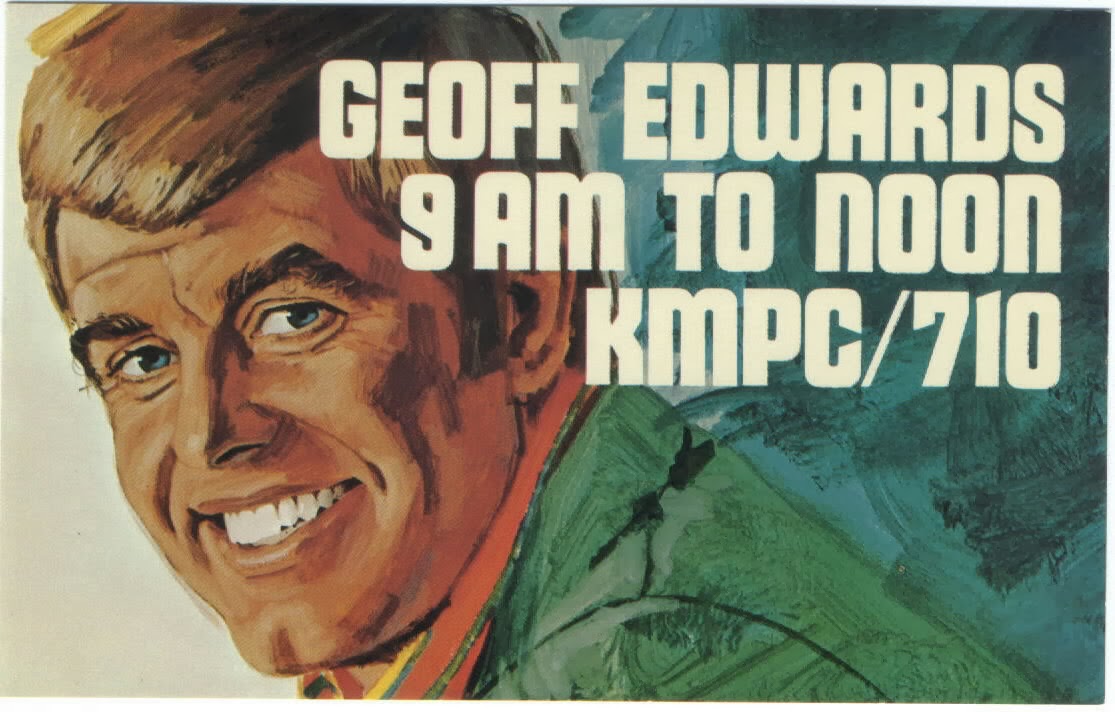
So sorry to hear of the passing of Geoff Edwards. I was shocked to learn he was 83. Geoff was always so youthful with such spirit.  I thought he was 40.  35 maybe.  As recently as last November Geoff contributed a piece for this blog. Most people probably know him as a game show host. He was also a radio star (back when there were such things), travel writer, author, and humorist.

We worked together at KMPC radio in Los Angeles. He was the 9-noon disc jockey and I was the lowly intern. But he always treated me as an equal. In many ways he was an inspiration to me because he didn’t have the classic radio baritone. But he had such personality and was such a terrific communicator that it didn’t stop him from getting plum jobs at some of the most prestigious major market radio stations in the country. He proved that having something to say was more important than just sounding mellifluous. That was my ticket too. Thanks, Geoff.

I’ll miss his sly humor, our lunches, his podcast, our friendship, and most of all his laugh.   Geoff Edwards was a breath of fresh on-air.

(My scheduled post follows later. Please check back.)

Wednesday, March 05, 2014

My short-lived stand-up career

This was going to be my big moment. It was the mid ‘70s and I was a disc jockey on B100 San Diego. The hottest group in America at the time was KISS and B100 was sponsoring their only San Diego concert. They sold out the 16,100 seat San Diego Sports Arena in like fifteen minutes.

I was selected to introduce them.

I had never done stand-up comedy but figured ‘what better place to start?’ Who needs open mic night in front of eight drunks on a Monday at 1 AM? I was a funny guy. I could skip a few steps. Go right to a sold out arena.

I asked how much time I could have and was told a couple of minutes. Perfect. I would write up five or six killer jokes. Piece of cake. And the audience knew me from the radio. So it’s not like I was a stranger. I felt sorry for all the poor stand ups who struggled for years in dive clubs and dive towns. Lucky me, I was able to bypass all that shit.

So I wrote some jokes. The smart thing to do might’ve been go to a comedy club and test out the material. A free rehearsal and a chance to fine tune. But no, didn’t do that. It’s only a few jokes. I’d been doing comedy on the radio for years. I knew how to sell a line.

The night of the concert I report backstage before the show. Lots of hustle and bustle. A greasy dinner is served in the bowels of the building for all the performers and crew members. Actually, the performers were in their dressing room either eating there, getting their make up applied, or more likely banging some fifteen-year-old girl. So it was me, roadies, and security thugs. The thought occurred: maybe I should try one or two jokes out on them. Get some feedback. Nah, either I was confident in the material or I wasn’t. I was so why bother?

The concert was supposed to start at 8. I was ready to go. KISS wasn’t. By 9 the audience was getting restless. Some chanting and stomping was heard. KISS was there. They had been in the arena since 3:00 for their sound check. Keeping the audience waiting was a calculated move. Never let it be said that KISS front man, Gene Simmons, wasn’t a savvy guy.

Now I’m getting a little nervous. Has waiting drained a little of my adrenaline? Will I still be able to deliver my lines with the same pizzazz? And how long should I wait for the laughter? It was a big cavernous barn. The big laughs might sweep across the Sports Arena like giant waves. I had to be prepared. And if the laughter was too big and long I might have to drop a joke. I decided which joke to drop.

Finally, the band joined me backstage and I was given the signal to go on.

I marched out onto that big stage and approached the mic. The sound was deafening. 16,100 crazed, stoned, drunk, impatient, surly kids screaming and some booing. Stage lights assaulting me. Like fireflies, thousands of lighters were held high by crowd members. I stood at the mic, surveyed the scene, and this was my first ever stand up routine.

“BIOO presents KISS!!!”

And I got off that stage as fast as I could.

That was also the end of my stand-up career. I figured, why not quit while I’m ahead?

Tuesday, March 04, 2014

Final thoughts on the Oscars

The ratings were up from last year. And considering no one saw any of the movies in contention, I’d say that’s a feather in Ellen’s cap.  Expect her to be back next year... if she wants it.

Big surprise that John Travolta believes in Scientology.  

What bothered me about the retweeting bit is that it was clearly so calculated to attract younger viewers. And what bothered me more was how desperate Liza Minnelli looked trying to squeeze into the selfie.

Sidney Poittier was not in top form. Kudos to Angelina Jolie for how classy and kind she handled that whole awkward situation. Someone noted that the music they played as he slowly made his way to the podium was “I Will Wait Forever.”

Cate Blanchett said that having Daniel Day Lewis as presenter exacerbated how good it was. Exacerbate means make worse. Probably what she meant was accentuated.

Usually Oscar hosts have long distinguished film careers.  Ellen may not have the screen credits but she was once a judge on AMERICAN IDOL.

Why was Pink chosen to sing “Over the Rainbow” over more established singers? Uh… what’s the audience the Oscars are trying to attract even more desperately than Liza wants to be noticed? 18-34’s. Barbara Cook is not going to get ‘em.

A number of readers wondered why Jack Nicholson was no longer in the front row smirking in his sunglasses. Probably because he’s never heard of half the presenters. “Zac Efron? Who’s he?”

When John Ridley won the Best Screenplay award for 12 YEARS A SLAVE he conspicuously didn’t thank director Steve McQueen. When McQueen made his acceptance speech later he ignored Ridley. Apparently there is bad blood between them. McQueen supposedly tried to get shared writing credit and the WGA disallowed it. Directors wield great power over writers. It’s kinda like that movie about a certain plantation owner.

Don't wanna say I toldja so but here was my review of 20 FEET FROM STARDOM.  I didn't think it would win an Oscar though because it wasn't set in a prison.

Fresh off her Oscar win, Lupita Nyong'o is back in theaters this week in NON STOP.  She has essentially a walk-on. 

At some point the price tag for the rights to air the Academy Awards is going to be so high that the paying network will get to demand the elimination of the production categories on the primetime telecast. You watch.

If Baz Luhrmann gave as much attention to the script as did the art direction, his wife might not be the only one in the family with Oscars. 

If John Travolta had introduced Karen O he would have said, "Here's Kenny G."

Instead of handing out pizzas, Ellen should have critiqued the singing performances.  

I guess I’m not the only one who thought AMERICAN HUSTLE was vastly over-rated.

Thank you ABC for not going from the In Memoriam segment to a promo for RESSERECTION. Or LAST MAN STANDING.

Just because Hollywood makes a good movie doesn’t necessarily mean audiences are going to find it. It might not play in your town, or it may screen in only one or two art theaters. It might not be promoted properly… if at all. Or the subject matter just doesn’t capture the public’s imagination. Unless IRON MAN 3 wins Best Picture there is always going to be somewhat of a disconnect between good and successful.

A number of you noted that THE WIND RISES should have won for Best Animation Feature. Maybe so but it had no chance over FROZEN.

After suffering through some of those endless acceptance speeches thanking lists of people that no one knows I missed playoff music.

If anyone wearing one of those beaded metallic gowns had spilled tomato sauce from the pizza on herself she’d have to get the dress cleaned at a car wash.

I look forward to next year's Oscars when they salute the 76th anniversary of THE WIZARD OF OZ. 

Monday, March 03, 2014

My 2014 Oscar Review

Not that it didn’t deserve to win, but I bet half the Academy members who voted for 12 YEARS A SLAVE never saw it.

The only other suspense of the night was whether Pharrell Williams was going to wear his hat, which tells you all you need to know about this Oscarcast. Long, dull, and safe with some musical numbers tossed in to distinguish it from C-SPAN.

Welcome to my 18th annual bitchy-but-fair Academy Awards autopsy; helped out this year by the comedy writing team of Annie Levine & Jon Emerson.

There has been less Oscar buzz this year than any I can remember. Not surprising when a Reuters’ poll found that two-thirds of Americans have not seen ANY of the Best Picture nominees. Of course that will all change now as throngs race to theaters to see 12 YEARS A SLAVE.

More on the show in a moment, but first – the traditional nod to the KTLA Red Carpet oozefest hosted by Sam Rubin and Jessica Holmes who now weighs less than her microphone. Sam is the king of hyperbole. At one point he said, “Now I’m joined by the biggest star of all, Al Roker.” Oh well, at least he didn’t mistake him for Samuel L. Jackson.

Hey, I’m just glad he didn’t tell director, Steve McQueen that he loved him in THE GREAT ESCAPE.

Other favorite Sam moment – saying to Leonard Maltin: “Any surprises that you anticipate?”

Ellen was a big improvement over last year. Of course, after Seth MacFarlane, Sacheen Littlefeather could have done a better job hosting.

I thought her monologue was quite funny even if Liza Minnelli didn’t. Liza with a Z did not seem to enjoy being mistaken for a female impersonator. She once beat the shit out of her husband for less.

Ellen’s bits with the audience were less successful. Don’t expect magic when you take selfies and pass out pizzas. The Oscars are not the place to wing it.

Winner Jared Leto managed to acknowledge Ukrainians, AIDS victims, and his agents. As he walked to the stage I was hoping the announcer would say, “This is the fourth nomination and first Oscar win for Jesus Christ.”

Annie observed that Julia Roberts looked like she had left a napkin in the front of her dress.

Meanwhile, Pharrell Williams showed up in a tuxedo and shorts. Come on, dude. It’s the Oscars, not O.G. Mad Eye’s funeral.

Oscar drinking game: Take a swig every time someone says “journey” or “dream.” By the first J.C. Penney commercial you’ll be blitzed.

Highlight of the night was Darlene Love belting out her acceptance speech for 20 FEET FROM STARDOM. She got an impromptu standing ovation.

No standing O for Karen O however. As Jon said: “It was like open mic night at a coffee shop.” Especially when every other singer killed it.

John Travolta is now officially a moron. He had only two things to do. Dye his hair any color found in nature and pronounce Idina Menzel. He could do neither. How do you get Adele Dazim from Idina Menzel? And this idiot has a pilot’s license? Holy shit!

As expected, Idina Menzel lit up the room with “Let It Go.” Was there ever any doubt that would win Song of the Year? For one thing – people have heard of it. Only downside: expect it to be covered by every AMERICAN IDOL contestant for the next five years.

Chiwetel Ejjiofer, Barkhad Addi, and June Squibb lost, but I’m sure the Academy figures they’ll all be nominated many more times.

Since when does Bruce Jenner go by the name Goldie Hawn?

Women wore a lot of beaded metallics this year. Thank goodness the rain stopped. It’s hard to return gowns once they’ve rusted.

Between Anne Hathaway’s short hair and metallic breastplate, it’s like she came as Ivanhoe.

Lupita Nyong’o’s acceptance speech was lovely and heartfelt. But too long. And she didn’t sing it. Did anyone else notice her play off music was from “Willy Wonka and the Chocolate Factory?”

The three inevitabilities of life: death, taxes, and Jim Carrey won’t be funny.

I think Matthew McConaughey won as much for TRUE DETECTIVES as DALLAS BUYERS CLUB. My partner, David Isaacs, said it best: He put on a shirt and became an actor.

What was with those pointless “hero” montages? “Hero” in Hollywood is just a euphemism for “movie star.”

How to win the award for Best Editing -- Cut your movie down to 90 minutes. That’s why GRAVITY won, Marty.

BAD GRAMPA and THE LONE RANGER were pretty much shut out. But so were AMERICAN HUSTLE and CAPTAIN PHILLIPS.

The set looked like the old Dunes Hotel in Las Vegas.

In a successful attempt to make the show gayer than the Tonys’, they saluted the 75th anniversary of WIZARD OF OZ complete with Liza Minnelli in attendance. It was also the 75th anniversary of GONE WITH THE WIND, but that would have looked like the Academy was taking the opposing view of 12 YEARS A SLAVE.

Pink did a nice job with “Somewhere Over the Rainbow.” Who knew she could sing without a trapeze? But that’s not the only song in WIZARD OF OZ. They could have featured “If I Only Had a Brain” and had John Travolta sing it.

Ellen came out dressed as Glinda the Good Witch. It was the first time anyone has ever seen her in a dress.

Where was Steven Spielberg to celebrate the achievements of his fellow artists? Oh right. He wasn’t nominated. Not there.

Bizarre moment of the night was Liza Minnelli hugging winner Lupita Nyong’o. Liza must’ve thought she was Diana Ross. Or her manicurist.

Jon said this about Tyler Perry: This is the first thing he’s presented that wasn’t Tyler Perry.

Anna Kendrick, Amy Adams, Kristen Bell, and Jennifer Lawrence were beyond stunning.

When Glenn Close started her preamble to the In Memoriam segment, she seemed so uncomfortable I thought she was introducing the writing categories.

I never understand why the audience applauds during the passing parade. It’s like when someone on Facebook posts that their mother just died and you click “like.”

How can the Academy say it’s too late to include Sarah Jones in the main body of tributes because she died two weeks ago and there was no time, yet Harold Ramis died a few days ago and he was included? Instead, they slipped her name in while going to break thus giving it the same reverence they give to promos for THE CHEW.

Bette Midler sang “Wind Beneath My Wings” but why? It was after the In Memoriam segment. This is supposed to be a solemn tribute not the 11:00 showstopper.

It still kills me that THE INVISIBLE WOMAN was nominated for Best Costume Design.

Harrison Ford is now too old to go on the Indiana Jones ride at Disneyland.

Could Charlize Theron possibly look any more bored if she was at the Aetna Insurance Actuary of the Year Awards?

Goldie Hawn introduced 12 YEARS A SLAVE with a smile so big you’d think she was announcing the Powerball Lottery winner.

Spike Jonz won for Best Original Screenplay. If they writer who is suing him for plagiarism wins, does he get an Oscar too?

Oscar nominee Julie Delphy said the Academy was " 90 percent white men over 70 who need money because they haven't done anything in a long time.” Shockingly, she lost. The only person in America who picked her in his Oscar pool was John Travolta.

Kim Novak will always be identified with VERTIGO. First the movie, and now it’s what you get when you see all the face work she’s had done.

I was thrilled that Cate Blanchett won. But now that someone thanked Woody Allen again on an awards show, expect five more moral charges to surface.

As usual, the show ran way late. But hey, we needed to see a montage of cartoon characters, Bette Midler singing an oldie, nine Best Picture nominees (with seven being schmuck bait), Ellen taking pizza orders, Twitter updates, sketches of the new motion picture museum, meeting student filmmakers, going through Lupita Nyong’o purse, and the umpteenth salute to WIZARD OF OZ.

The post Oscar parties had to be more fun. I can just imagine John Travolta approaching one of the producers of 12 YEARS A SLAVE and saying: “So what is the movie about?”

Sunday, March 02, 2014

It all started with the Oscars

SHAKESPEARE IN LOVE had just beaten SAVING PRIVATE RYAN for film of the year. Steven Spielberg, who had already won Oscars for SCHINDLER’S LIST in every category except Best Animated Short was really pissed. And this was mere moments after he won another Oscar for directing SAVING PRIVATE RYAN (which was very well deserved, by the way). I thought it was a little ungracious. So I decided to write a humorous review of the ceremony, poke a bit of fun at Hollywood royalty, and email it to the hundred or so people in my address list.

The response was so positive that I did it again the following year. By then my list had grown to at least 104. I added the Emmys (talk about an easy target) and also goofy travelogues.

Once I compiled enough of these travelogues I investigated getting them all published as a book. The idea was met with zero interest. But one kindly editor said, “These are very funny and if Dave Barry had written them I’d publish them tomorrow. But no one knows who the fuck you are.”   (I ultimately published them myself and the hilarious Kindle version is only $3.99.)

So how do I become more well-known? First thought was a publicist until I saw what they charged. Yikes! I wanted a little higher visibility; I didn’t want to be Miley Cyrus so paying big money to get my name in the Long Beach Telegram a few times a year didn’t make sense. Nor did killing anybody or competing in the Winter Olympics.

Then my friend Howard suggested writing a blog. (This is beginning to sound like one of those old cigarette commercials. Then my priest said, “Hey, have you tried Viceroys?”)

A blog wouldn’t cost anything save for time. Who knows? It could lead to a big book deal, major speaking engagements, or taking over for Carson Daly (if not me than ANYBODY). Well, none of those things happened but the blog has been great fun to do -- now in its ninth year of daily posting. And it has gained some popularity (now 11,000,000+ visitors) – thanks in part to my annual Oscar review.

Anyway, tonight I shall once again review the Academy Awards.  So much suspense.  Will GRAVITY beat 12 YEARS A SLAVE and AMERICAN HUSTLE?  Will Ellen wear a dress?  Tomorrow morning the review will be up. 

Just think, if Steven Spielberg had only clapped when SHAKESPEARE IN LOVE won none of this would have happened.

Saturday, March 01, 2014

The first televised Oscars

The Oscars were first televised in 1953.  Bob Hope was the host.  Here's his opening monologue.  Most of the jokes are making fun of TV.   Return to the days when the Oscar ceremony was truly elegant and 3D glasses were a novelty.    Wait a minute -- they still are.  (The glasses, not the elegance.) 

As usual, I will be reviewing the Oscars Monday morning.

The inside story of the Niles silent scene

A few years ago I ran a couple of Comedy Tests.  I would show classic sitcom scenes and get your reaction.   One was the classic David Hyde Pierce silent scene from FRASIER.  David Lee, the co-creator of FRASIER was nice enough to share the whole backstory of the DHP scene used as Comedy Test Part 2. For those who don't read the comments, I thought I'd repost it so everyone can see.

Thanks much, David.

Several thoughts from David Lee.

Prize goes to the poster who said it reminded him/her of Mr. Bean. I had recently been introduced to his work and loved a lot of it. I told DHP that I would like to do something like that for him on the show. Couldn't really come up with anything for a while (we didn't want to crib the "turkey on the head" bit,though that wasn't a concern of another sit-com on the air at the time. I do remember in the room having trouble breaking a Valentine story and hitting upon the idea of doing three short stories instead. Two of them involved every character except Niles, so the idea of something for him alone came up. Then the Mr. Bean thought, and then the fire idea. I remember distinctly that once we hit upon that, the details of it came together very, very quickly in the room.

Because of safety concerns, the scene was filmed without the usual studio audience. ( It was played to a studio audience later, and those are the laughs you hear). It also had to be done in bits and pieces. The problem is, when there is only one person on stage, what do you cut to? That's where the dog came in--not out of an attempt to be cutsie--but rather to be able to piece it all together.

And of course, as many have said, none of it would have worked without the brilliance of DHP. A wonder he is.

And to the poster who wondered who would make all those mistakes with an iron, fire extinguisher and cleaning materials: how about someone who never or seldom uses them?
A side note now that my memory has been shaken: This was the episode that caused a showdown with the network. We had been complaining that they were giving away plot points and great jokes in their promos for quite awhile, and we knew that every promo would for this episode would be nothing but flames galore. So we did not deliver this piece of it until the day of broadcast. Apoplectic, they were. Lawsuits threatened, even. But they finally came up with a better promo that said something like "The producers of Frasier think this episode is so special, they won't even let us see it."

Now back to my couch.

Once again, thanks to David Lee for posting this originally in the comments section. Check out the comments, folks. They're often times better than the posts.

Friday, February 28, 2014

Friday Questions

Friday Question time already? Where did the week go? (That’s not an official Friday Question.)

Kim T. Bené asks:

M*A*S*H had first rate acting, memorable characters, an unusual premise... and of course incredible scripts. However the audio was lousy. When they were shooting outside it was fine. But when they shot exterior scenes in the studio the audio was always echoy and sounded exactly like they were simply shooting film in a big metal warehouse. When they shot interiors in the studio the audio was OK because the "buildings" were all tents so the fabric muffled the echo but you can close your eyes and pick out every single scene shot as an exterior inside the studio. What gives?

Funny you should mention that Kim because that was always one of my pet peeves and drove me crazy.

We filmed MASH on Stage 9 at 20th. All of the tents were set up and a huge backdrop was erected allowing us to shoot exteriors. Normally we shot all exteriors out at the Malibu ranch. We shot one day per episode and to maximize the light, cameras rolled from sunup to sundown. That was fine in the summer when the sun went down at 8:15. But once we went to PST it was dark before 5:00. So for the remainder of the season we shot exteriors on the stage. Generally that meant the last six or seven shows.

Because of the audio problem (and the lighting difference – especially daytime scenes), when David and I were head writers we stayed clear of those scenes unless we absolutely had to have them. And if we did, the scenes were super brief. Lots of activity like triage or people running from one place to another.

I complained about the sound and was told nothing could be done due to the acoustics. I’m sure today you could equalize and fix the sound with an app you could buy on your phone for $0.99.

But I used to joke whenever we were forced to do an exterior scene on the stage that we were going to the Brady Bunch backyard.

Chris queries:

Is there a rule that says when you cut back and forth between two scenes, they have to be happening at the same time?

I was watching the second episode of HBO's "Looking" and they cut between a scene where a lawyer meets with his clients and one where one of the other characters was out clubbing at night. It felt weird that a lawyer would meet clients at 10 pm, but it also didn't feel right that the meeting was taking place during the day and the other scene was in the middle of the night, while they cut back and forth between them.

There’s not a rule but it’s generally accepted that when you cut between two scenes they’re in the same time frame. Woody Allen violated this in TO ROME WITH LOVE. He had multiple stories going. One was over three days, another was over one afternoon. The end result was that the movie was a confusing mess. If the audience can’t place the time or geography they’re taken out of the scene. Yes, directors could argue it’s a creative choice, but why do anything to take the audience out of the show? That said, I think Woody Allen has been accused of worse.

From Angry Gamer:

I have noticed that your blog posts seem to follow a familiar pattern.

Something like this:
Intro (general info)
Inside Scoop (details from the trenches)
Little Joke
Middle Exposition (marking time, biz story time, setup)
BAM - BIG JOKE
Last Story or Observation
End Credit or zinger one liner

So... is this deliberate? Is this the off the cuff organization of a genius comedic writer? What gives?

The genius part is correct. No, seriously, I consciously do the following:

Try to keep the posts fairly short. Maybe one page. People don’t want to read a seven-page article every day. Certainly not from me.

Sprinkle some humor in there somewhere.

Ask myself the question -- is this topic funny, interesting, or informative enough to consider?

End with a wrap up that ties things together.

Other than that, I have no idea what I’m doing.

And finally from Hamid:

When you made it as a successful writer and your name was on TV, did lots of people you hadn't seen or heard from in years, including any who gave you a hard time at school, start coming out of the woodwork wanting to hang out with you?

Not enough of them.

When David and I first started selling scripts, a number of my friends began writing specs as well. The message of course was: “If Levine could make it, anyone could.” Ironically, none of these friends could even finish their specs.

When I was on MASH I went to my 10 year high school reunion. Several people approached me at various times of the evening and said, “Is that you on MASH? We see your name every week and can’t believe it’s you.”

But generally, no. The people who had no use for me before I became successful still have no use for me. I have to admire their integrity.

However, for all the girls who told me to get lost when I asked them out, I hope when they see my credit this is what they see:

                                                Written by:
“The guy I should have gone out with and been nice to instead of the jerks I did date which is why I’m now divorced and living in a trailer park in the Mojave Desert”
                                                        &
                                                 David Isaacs

What’s your Friday Question?

Thursday, February 27, 2014

In honor of Jim Lange

Who passed away this week at 81, I'm reposting a section from my '60s book on how I was thrown off of THE DATING GAME (which he hosted).   Jim was a great guy.  I got to work with him at KMPC.  Easygoing and fun.  Later I became a disc jockey at KYA in San Francisco and would hang out with Jim and other local bay area radio greats at Perry's on Union Street.  Jim -- a big kiss goodbye, my friend.

It was in the late 60’s, I was in high school, and someone recommended I try out for THE DATING GAME. This was a popular game show on ABC at the time. Three bachelors would be asked inane questions by a girl who couldn't see them and based on the answers she'd select one for her "date".

I was a wise-ass even then (as opposed to say... now). So I called the show, was given an appointment to audition. The first thing I said when I got there was that my father worked for ABC radio and if that was a conflict let me know now and save us all a lot of time and trouble. They assured me that was no problem. In fact, they said members of their own staff have had to go on in emergency cases.

So I went through the audition process. They put 40 of us in a room and asked us random DATING GAME-type questions.

A week later they called and invited me to be on the show. Everyone wonders if bachelors are given a preview of the questions or get to see the girl in advance. The answer is no. They filmed three episodes at a time so nine of us reported to an assigned room. We were briefed, then ushered to the stage for a rehearsal. They walked us through it, where we sat, what to do after the girl made her selection, etc. Then it was back to this waiting room until we were called for the show.

I didn’t give a shit about winning the date. I just wanted to get big laughs. And I was lucky. Got some good questions, had some funny answers, called one of the other bachelors a blimp, just wreaked as much comic havoc as I could. Big surprise, I wasn’t selected. As a result I missed getting to go on a little cruise boat around the Newport Beach harbor with the Turtles. (I’ve since become friends with Howard Kaylan and he can’t even remember that event).

Two days after the show aired I got invited to go on again for their alumni show. Again I was apparently funny. I just remember doing an Elvis impression and trashing the institution of marriage. This girl didn’t pick me either. Instead I went home with 50 pairs of Ray-Ban sunglasses or something useless like that. I think the date I missed was to the Lancaster Date Festival. I’ve since gotten over my disappointment.

After that show aired they invited me to be on the night-time version. Now that was big stuff. Winners got trips to Europe and Hawaii, not Orange County. Oh yeah, and you’d be on national primetime television… but it was really the prizes.

Unfortunately, there was an engineers’ strike at ABC at the time and management had to man the cameras. During the rehearsal, one of the cameramen recognized me and mentioned casually that my father worked for ABC radio. Chuck Barris went ballistic. I was immediately thrown off the show. I said, “But what about when your own staff has to sub…?” Their answer was, “Get out!” So that was that. I was bumped from the show, they grabbed a guy in the audience who was wearing a suit, and he went on in my place. The selected bachelor got a trip to Paris. I got a roast beef sandwich at Arby’s.

A few years later when I was working as an intern at KMPC radio in Los Angeles. Jim Lange was hired as a disc jockey. He spotted me down the hall and amazingly, remembered me. Even rattled off my blimp quip. Two days later at the station I get a call from THE DATING GAME. All was forgiven. They’d love to have me on again. I said, “Is this the night-time version?” They said no, I’d have to go back to daytime. So I told them to stick it. And thus ended my storied DATING GAME career.

Do I have regrets? Yes. I wish I had some of those sunglasses today. I could get a FORTUNE for that crap on ebay.

How NOT to pitch a pilot

Pitching pilots to networks is somewhat of an art. I mean, it’s not Adele singing or Linda Lovelace eating a cucumber, but it does take a certain skill. My writing partner, David Isaacs and I have been pitching pilots for years. We don’t sell them all but we have sold quite a few. So we have some sense as to what’s involved.  (And it's closer to what Linda Lovelace does.)

Generally, we keep our pitch down to about fifteen minutes. We never read. We may go in with a sheet of bullet points or no notes at all. We explain the premise, the theme, and what about the project excites us. We introduce the characters briefly, and offer possible story suggestions for down the line. Along the way we integrate a few jokes.

The idea is to spark their interest in a way that they can actually picture the show on their network. We answer any questions and keep the dialogue going for as long as we can. The more they talk about it, usually the more interested they are.

Generally the whole process is over in a half hour and we leave. Networks tend to bunch their pilot pitch meetings together so we know they already heard three pitches this morning and two more are scheduled after us. It must get very tedious hearing all these pitches back to back. I don’t envy them.

But that’s what we do. And like I said, we’ve had a fair amount of success.

A few years ago we met with a non-writing producer who told us he had a pilot sold at Fox but needed it developed. The money was good, the timing was right, the idea was decent enough that we said we’d attach ourselves to the project.

We crafted characters and developed the pilot. Then this producer, we’ll call him Slick Sam, told us we had to pitch it to Fox. Why? They already bought it. Well, it seems they hadn't already bought it. They just liked the area. Strike one.

Okay, we’ll pitch the pilot.

Slick Sam wanted us to come in so we could rehearse and refine our pitch in front of him. We said that wasn’t necessary. We knew how to pitch. A family loved one was in the hospital at the time so I was also spending a lot of time there.

A date was set for the pitch and the day before Slick Sam calls. He’s nervous. He really wants us to come in and rehearse the pitch. I say no. At the time I’m in a hospital room. He asks me to then do the pitch on the phone. I reassure him that we’ll be fine and hang up. Strike two.

The pitch was at 2:00 at Fox, right after lunch. We met with Slick Sam a few minutes before. The premise involved food. Two minutes before we were going to go upstairs for the meeting his assistant arrives with giant grease-soaked bags. Slick Sam, ever the showman, had brought food for everybody to liven up the pitch. Greasy, disgusting BBQ food.

We told him to leave all this shit outside. This was a bad idea. But he was the master showman and insisted. We troop into the Comedy VP’s office and Slick Sam’s assistant starts laying out the food. Thick gloppy ribs, congealed brisket, beans, sauce, hot links – you name it. The Fox execs were repulsed. Plus, it was right after lunch. I would bet money that office still smells of BBQ food to this day.

Needless to say, it was the worst pitch ever. They couldn’t wait for us to finish so they could clear that lethal shit out of there. The pilot didn’t sell.  Strike three.

We walked out of that meaning and immediately told Slick Sam we were done. “But we have three other networks to pitch,” he pleaded. “Not with us,” we said.  We were out of there like the Road Runner.

Stunts don’t sell pilots. Nor do flashy power point presentations. Ideas sell. Ideas that fall within the parameters of what they’re looking for at that moment. If you have so little confidence in your idea or your ability to pitch that you have to resort to St. Louis style ribs then you don’t belong in a network VP’s office wasting her time. Unless you’re prepared to hand out half slabs to 10 million viewers, concentrate on the idea, not the catering.